AI Bubble, Rate Rises and Chokepoints at the Forbes Global CEO Conference
An AI bubble called close to its turn, a sharp split on interest rates, and a bond market that may settle the argument. What boards should take from it.
· 7 min read
Infinite Horizons · Signal Stack · Ray Ferguson · Singapore · 8 October 2026
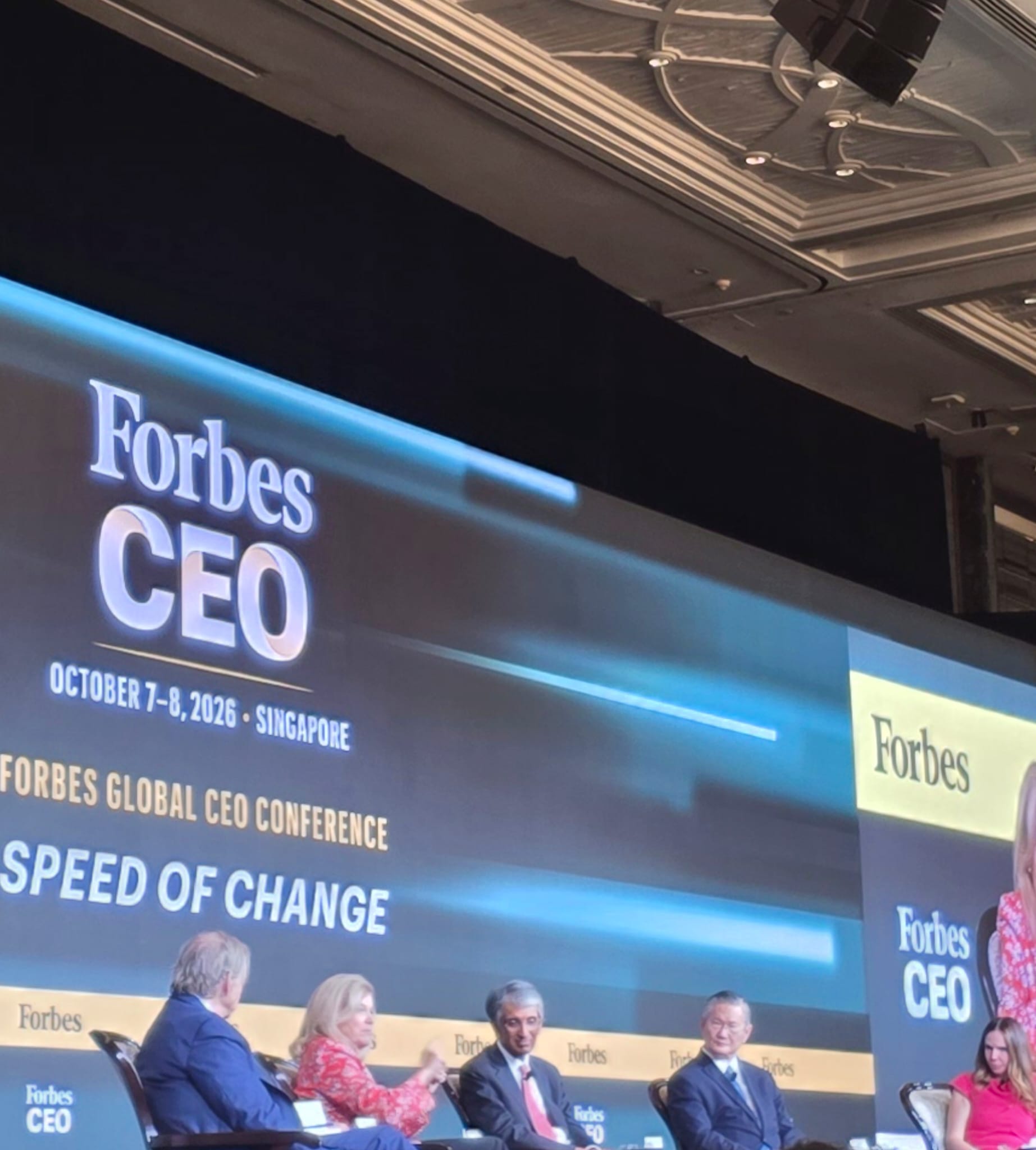
The room
The most useful thing said at yesterday’s Forbes Global CEO Conference in Singapore came from an owner. Ray Dalio supplied the warning and Steve Forbes the dissent, and Temasek’s chief executive set out the discipline that lets a board survive whichever of them turns out right.
It was one of the most interesting line-ups I have sat through in years, and it is worth sharing at length.
The morning panel brought together Dalio of Bridgewater, Dilhan Pillay Sandrasegara of Temasek, Jenny Johnson of Franklin Templeton and Chartsiri Sophonpanich of Bangkok Bank, known to most of the room as Khun Tony. In the afternoon Steve Forbes, the host, spoke on money, trade, wars and AI.
Their views diverged, sometimes sharply. Three themes ran through the day that Signal Stack and Tech Stack have been working through for months: the chokepoints that energy and trade now depend on, the falling price of intelligence set against the cost of the capacity being built to supply it, and a world in which power decides more than procedure.
A classic bubble, close to its turn
Dalio sees five forces arriving together (debt, domestic politics, geopolitics, nature and technology) and a markedly more disorderly few years ahead. On technology he was blunt, and widely reported. Every great technology has produced a bubble. His own bubble index now reads close to 2000, and 2000 read close to 1929.
The mechanism is the gap between wealth and money. A start-up raises a small round at a lofty valuation and a billionaire appears, with net worth nobody can spend. A bubble pricks when enough holders must sell at once, usually to service debt, sometimes to pay a tax. On timing, he placed us before the point where higher rates bite, and close to it.
The morning after
Dilhan drew the line the rest of the panel had circled. An investor who judges the risk too high can rotate, diversify or sit in cash. An owner cannot. In his words, you “own the morning after”. Profound.
When COVID grounded Singapore Airlines, Temasek backed the rights issue that kept the fleet renewal going. Only buffers built in advance made that survivable. Then the data centres. Temasek’s ST Telemedia sold its data centre business to KKR and Singtel in the middle of the AI rush. The business borrowed on the strength of Temasek’s triple-A rating, and every further gigawatt meant another $10bn or more of balance sheet, exposed to rising rates and to cooling technology that could change underneath it.
The counterfactual is trading in New York. Oracle kept building on its own balance sheet. Its credit now sits one notch above junk, and its own filing marks its debt at about 85 cents on the dollar. The market is pricing a single name, but it is a fair picture of the morning after for an owner that kept the asset.
Dilhan’s last point belongs on every board agenda this quarter. So much capital is moving into AI infrastructure that the money left for adoption, and its cost, is now a live question for every company that borrows at the extant rates to transform.
The depreciation nobody has booked
The moderator sharpened the bubble question. The largest US hyperscalers will spend around $700bn this year, most of it on AI data centres, and only a fraction has reached an income statement, because depreciation starts only when a facility goes live. Today’s AI earnings flatter the economics.
The last Tech Stack set out how open-weight models now carry most of the traffic on the platforms that publish numbers, for a small share of the spend. If the price of intelligence keeps falling that fast, some of this capacity will be depreciated against revenue that never arrives at the price the model assumed. Ask for the schedule now. Book the depreciation.
The case against the medicine
In the afternoon Steve Forbes disagreed with half the morning’s panel. Raising rates to fight inflation, he said, is “one of the dumbest things that’s happened in modern times”. Today’s price pressure comes from a war-driven energy shock, and a slower economy will not reopen a pipeline. Treating it with higher rates is, in his phrase, like bleeding the patient. The IMF published the strongest rebuttal this week: cost-of-living crises lift inflation expectations for years after the energy spike fades.
His alternative is sound money, and his model sits on our doorstep. Singapore borrows for ten years at less than half the American rate, and more cheaply than Tokyo. MAS steers policy through the exchange rate and sets no policy rate at all. Forbes predicts floating currencies will give way, after a crisis, to a system in which gold again plays a central role.
The queue is setting the rate
Dalio expects higher rates to prick the bubble, and Forbes thinks raising them is the error. This week’s markets make the Fed argument almost moot. The Fed has signalled patience, and the US 10-year has kept climbing to its highest since 2002. Hours after Dalio left the stage, a Treasury auction cleared at the highest yield in a quarter of a century.
Anyone who has sat close to a dealing room learns that a market is a queue of buyers, and the price is set by the last one still willing to stand in it. The AI builders are now the largest new arrivals in that queue, accounting for roughly half of new US investment-grade bond issuance this year.
My own read sits between the two men. Forbes has a point that a policy rate cannot reopen a pipeline. Dalio is right that rates will do the pricking. The rates that matter are the long ones, set by that queue, and the AI build is now large enough to push them up. The boom is helping to set the price of money that Dalio expects to end it. That is Dilhan’s adoption point in practice: the company borrowing to adopt AI stands in the same queue as the Treasury and Oracle. The refinancing calendar, the concentration of lenders and the depth of committed liquidity belong on the board agenda, in that order.
The window
Dalio has named the stretch between the US midterms and the 2028 presidential election as particularly risky. Forbes forecast that, voting today, the Republicans would lose both houses on 3 November. The calendar matters. Boards approving three-year plans this quarter are approving them straight through that window.
The region in the middle
The Southeast Asian voices were calmer. Khun Tony called the region “an oasis of stability and also calm”. Dalio agreed that ASEAN’s moment has come, with value in companies AI is changing that carry no AI label. Most boards in this region sit exactly there, as adopters. On Dalio’s reading, they hold the undiscovered value. On Dilhan’s, they also carry the cost-of-capital risk. Both readings are true at once, and the second arrives first.
Forbes added the one note this audience should not skip. He listed the Strait of Malacca alongside Hormuz, the Red Sea and the South China Sea, and asked whether tolls might follow. Indonesia’s finance minister floated exactly that in April, and his foreign minister ruled it out the next day. Boards should still note that a finance minister said it aloud. Signal Stack has tracked who gets to charge for Hormuz and watched Bab el-Mandeb fall. After that year, the question no longer sounds absurd in a Singapore ballroom. It belongs to the world of power over procedure read from the floor of UNGA 2026.
The honest limit
Not everyone on stage was bearish. Jenny Johnson called this one of the most remarkable technological advances in history, with the overinvestment that always comes with one. Dalio himself cannot date the turn, and close was as far as he went. “Being in the markets teaches you humility,” he said. Forbes’s gold call deserves the same caution: in a war year with yields at multi-decade highs, gold sits a quarter below its January record. A board that swithers until someone dates the turn will wait for ever.
What Dilhan described is a discipline any board can adopt: buffers set before they are needed, a balance sheet that can carry a bad year and a worse one, and the nerve to sell an asset at the height of its story when keeping it would put the parent’s rating behind the bet. For the AI budget, it means sizing the commitment so that either error is survivable, and knowing what capital will cost the adopters as well as the builders.
Boards own the morning after. And the window opens next month.
Ray Ferguson writes the Infinite Horizons Substack on leadership and judgement in a messy world. Signal Stack reads geopolitics, markets and structural change. Tech Stack reads AI, technology and cyber. Each edition is written plainly, for board-level readers, with evidence ahead of opinion and no patience for jargon. Full archive of previous Signal Stacks. The wider body of work lives at ferguson.sg. Ray is a chairman and international banker with 35 years of leadership across Asia, the Middle East, Europe and the Americas. Former CEO of Standard Chartered Americas, CEO of Standard Chartered Singapore and SEA, UAE and Oman, and Deputy CEO of Bank ABC, Bahrain. Chair of insurer Singapore Life, 36ZERO Marine Group, and ESGpedia, Asia’s leading ESG data and technology company. Views expressed are personal. Singapore citizen, ocean sailor, Criticaleye board mentor, and author of Infinite Horizons: Seasons in The Sun, Life & Leadership Lessons, published by World Scientific and available now. It sets out what that career taught him about counsel, stewardship and endurance, and about the discipline required to sustain a life alongside the work. It takes the form of a memoir at its core. All author proceeds go to the Wheelchair Rugby Association (Singapore).
Join the conversation
Comments and replies take place on Substack, where Ray reads and responds.
INFINITE HORIZONS
Get each edition by email
Free. Delivered by Substack. Unsubscribe from any email.
Infinite Horizons is published by World Scientific and available now.
Buy the book