

The first shots have been fired. The next 72 hours will determine everything.
The GCC axis has broken. A US warship was engaged at Jask. UAE takes multiple attacks. My balance still favours negotiation, but only just.
· 6 min read
Infinite Horizons: Signal Stack Series · Ray Ferguson · Singapore 2345 5th May 2026
This is not a drill. On 2 May I published The Two-Week Window, holding 65/35 in favour of kinetic restart. On 29 April, in Rebuilding the Room, I traced the structural fracture in the GCC: the UAE OPEC exit, the petrodollar stress, the institutional plumbing cracking in public. Day one of the two-week window has confirmed that fracture is no longer structural. It is operational. The balance has shifted. I am not attaching a number tonight. The Jask facts are still incomplete and false precision does not serve readers who have capital or decisions at risk. What I can say is that the analytical case for the 65 is gone. Here is why.
Military and civilian signals
Iran’s Fars news agency reported two missiles struck a US Navy frigate near Jask after it ignored warnings to halt.
CENTCOM denied any vessel was struck. A senior Iranian official told Reuters a warning shot was fired and damage was unclear. Two US-flagged merchant vessels completed the passage safely. Read the denials carefully. CENTCOM said no vessel was struck. It did not say no missiles were fired. It did not say no US warship altered course. Iran’s unified command said the vessel was “unable to continue its route” and “forced to retreat.”
Both sides are managing the disclosure of an incident neither wants to own, because owning it forecloses options. That gap is the signal. One detail from Axios that has not received enough attention: on Thursday night Trump was presented with a plan to open the strait by force. He pulled back. He chose the cautious Project Freedom approach instead.
The full kinetic option was on the table four days ago. He chose not to use it. Whether that restraint holds after Jask is the question Monday has opened. CENTCOM’s force package is not humanitarian in any military sense: guided-missile destroyers, more than 100 aircraft, 15,000 service members, with rules of engagement authorising strikes on IRGC fast boats and Iranian missile positions.
That is a combat posture. Alongside Jask: two commercial vessels attacked, a UAE energy vessel droned, a South Korean cargo ship hit. Then, as Monday evening developed, the picture widened materially. UAE air defences intercepted 15 missiles and 4 drones fired by Iran across the country. Friends in Dubai reported hearing the alerts. A drone struck the Fujairah Oil Industry Zone, the UAE's only oil export outlet outside the Gulf, and started a fire. UAE authorities closed schools for the rest of the week. The IRGC applied pressure across every vessel category and every layer of UAE civilian life simultaneously. This is not escalation posturing. This is the new maritime regime being enforced.
Diplomatic layer
The most underweighted analysis today concerns a statement made four days ago. On Thursday 30 April, Supreme Leader Khamenei issued a rare public statement vowing not to surrender nuclear or missile technologies and signalling permanent Iranian control of Hormuz. The IRGC at Jask was not freelancing. It was executing a standing order from the highest authority in the Iranian state, issued publicly, before Project Freedom launched. This collapses the two-government framework I built in The Same Signal, Opposite Conclusions on 3 April.
The supreme leader, the IRGC media sourcing the 14-point proposal, and the IRGC naval forces at Jask are now saying identical things on the same day. The 14-point proposal is not a negotiating document. It is the terms on which Iran will end the war. Permanent sovereignty. Transit by permission. No return to pre-war conditions. Those are not parameters. They are foundations.
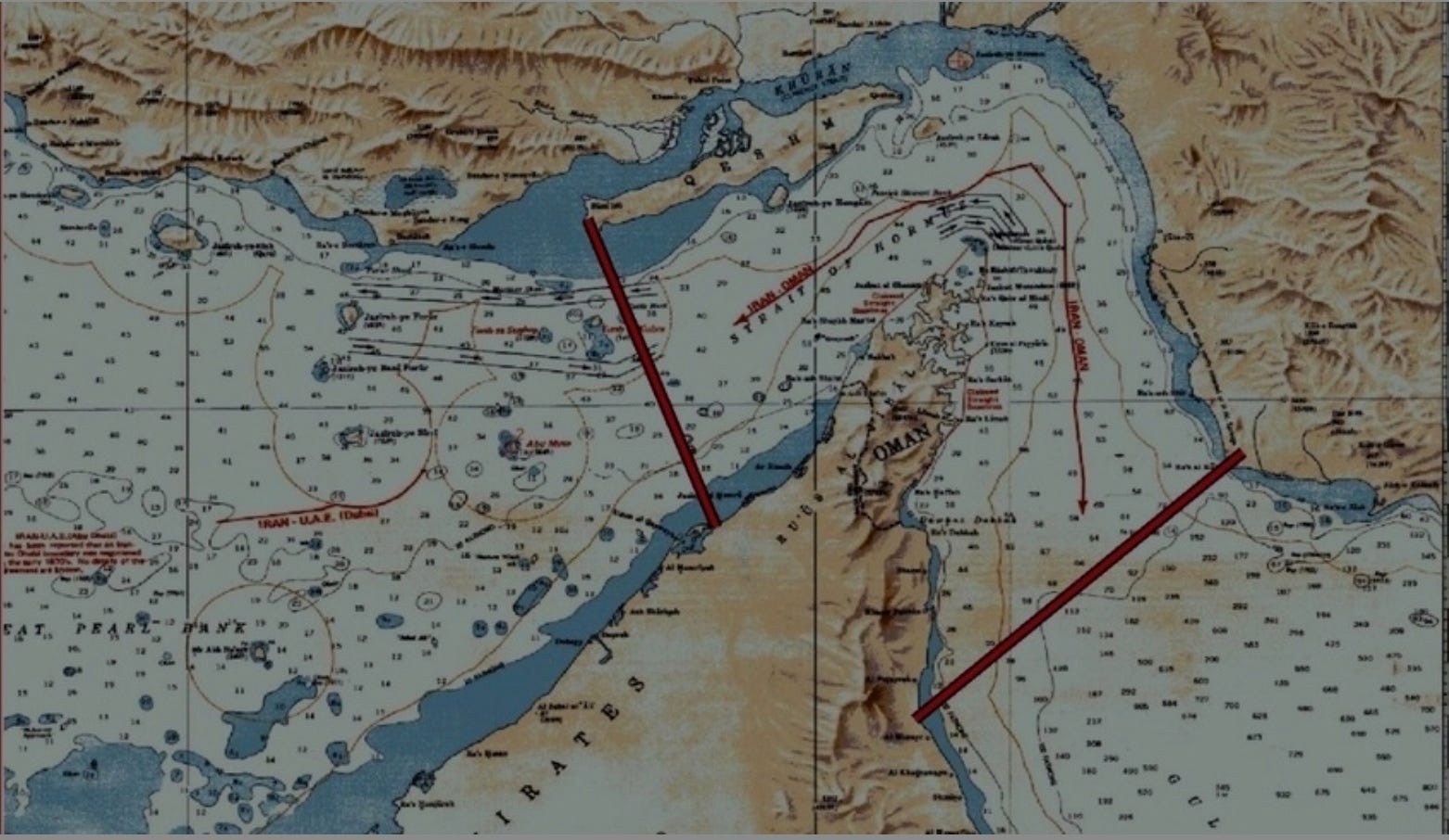
Hours later the IRGC published a map. The control zone runs from Qeshm Island west to Umm Al Quwain in the UAE, and from Mount Mobarak east to south of Fujairah. The eastern boundary lands on the emirate Iran struck with a drone on the same day.
The map and the Fujairah attack are a single coordinated statement: this is our water, and we will demonstrate control of its coastline. The map is the supreme leader's Thursday sovereignty declaration drawn in coordinates. Same claim. Different medium. The map is defiance.
It is also bait. Published on the day Trump announced his midnight Tuesday deadline, it is maximalist in its geographic reach, extending Iranian control to Fujairah on the Gulf of Oman, outside the strait itself, and naming the US Army directly as the target of its warning.
The IRGC knows a bridge and power plant strike is legally contested and domestically unpopular in Washington. A sovereignty map that forces Trump to either accept Iranian control of the world's most important energy waterway or strike civilian infrastructure is designed to make both options painful. Iran is not reacting to the deadline. It is shaping the terms on which Trump must respond to it.
Market pricing and the GCC fracture
Oil up 5 per cent to $115. The market is right. But the oil price is not the only financial story.
The GCC financial architecture story is. UAE infrastructure damage, production down 44 per cent, dollar revenue gaps widening, drove Abu Dhabi’s central bank governor to Washington for a dollar swap line with Bessent and the Fed. Bessent backed it publicly before the Senate.
Within days, the UAE exited OPEC. The two events are not confirmed as a negotiated transaction.
No quid pro quo has been stated publicly. The strategic logic connecting them is direct and the timing is not coincidental, and that is reason enough to take the connection seriously as an analytical hypothesis rather than a confirmed fact. Behind it sits the barrels-in-the-ground calculation.
The UAE holds 97.8 billion barrels of proven reserves targeting 5 million barrels per day by 2027. Foregone revenue at the quota-capacity gap runs to $46-58 billion annually.
The OPEC exit is best understood as an advance call on those reserves: monetise volume rather than manage price, with the swap line as the liquidity bridge while Hormuz is contested.
Riyadh was not consulted. Riyadh learned from a press release.
The 59-year partnership, the institutional plumbing I watched operate from several seats, and which I described cracking in Rebuilding the Room, has fractured in a way that does not easily repair. Whether the GCC survives as a functional institution is now a genuine open question.
The credit architecture underwriting Gulf expansion is under simultaneous stress from dollar gaps, fractured solidarity, and a monetary system contested at the chokepoint through which the revenue flows.
The balance and the watch items
The case for negotiation still stands, narrowly. Two ships transited. The Pakistani channel is open. Trump had the kinetic option on Thursday and chose not to use it.
My balance still favours a negotiated outcome, but with much less conviction than at any point in this ceasefire, if indeed we are still calling it that.
The watch items have multiplied. First: the next CENTCOM statement, and whether it addresses whether missiles were fired at a US warship, not whether they connected. That distinction is the line between a deterrence incident and a casus belli for Washington. Second: whether the UAE, which has until now absorbed Iranian strikes with restraint and managed its response through diplomatic channels, concludes that Monday's attack on the Fujairah Oil Industry Zone, its only non-Gulf oil export outlet, crosses a threshold that requires a direct military response. The UAE has been the most targeted country in this conflict. It has exercised more restraint than any other actor in proportion to the damage it has absorbed. The Fujairah strike was not a missile intercepted over the sea. It was a drone that landed, started a fire, injured workers, and closed schools across the country for the week. Abu Dhabi will be deciding tonight whether that changes the calculus.
That is the line between a deterrence incident and a casus belli. Churchill wrote in The World Crisis of Agadir: they “were prepared to go to the very edge of the precipice. It is so easy to lose one’s balance there: a touch, a gust of wind, a momentary dizziness.” The Gulf has had its Agadir.
Watching CENTCOM. Watching the ships. Watching UAE statements.
Signal Stack is part of Infinite Horizons, published by Ray Ferguson. Ray is a chairman and international banker with 35 years of leadership across Asia, the Middle East, Europe and the Americas. Former CEO of Standard Chartered Americas, CEO of Standard Chartered Singapore and SEA, UAE and Oman, and Deputy CEO of Bank ABC, Bahrain. Chair of insurer Singapore Life and 36ZERO Marine Group. Singapore citizen, ocean sailor, board mentor, and author of the memoir Infinite Horizons: Seasons in the Sun: A Memoir of Leadership and Life. He writes on geopolitics, markets and leadership. If this analysis is useful, share it with someone who needs it. Subscribe free to receive Signal Stack and Tech Stack directly.
Join the conversation
Comments and replies take place on Substack, where Ray reads and responds.
INFINITE HORIZONS
Get each edition by email
Free. Delivered by Substack. Unsubscribe from any email.
Infinite Horizons is published by World Scientific and available now.
Buy the book

