

Any Vessel
When financial coercion crosses into salt water. A longer read than usual, unapologetically. The subject warranted the depth.
· 9 min read
Infinite Horizons: Signal Stack Series · Ray Ferguson · Singapore 25 April 2026
On Thursday I published “Reading Chokepoints while looking out at Malacca” on Infinite Horizons, written from the Sentosa seashore with Fishman’s Chokepoints in one hand and two ministerial statements in the other. Indonesia’s Purbaya had floated a Malacca transit toll. Singapore’s Balakrishnan had declared Malacca transit passage non-negotiable. Forty-eight hours on, with Friday’s Pentagon briefing now in view, the chokepoints argument carries more weight than it did on Thursday. This piece develops it against the facts on the ground.
The 24 April briefing by Hegseth and Caine crystallised what the chokepoints thesis has been missing. It enters below as the linked insight extending Fishman’s argument. The subject is chokepoints.
The Fishman thesis, and the propagation problem
Fishman’s Chokepoints is a New York Times bestseller and a Financial Times Business Book of the Year finalist. He served on the State Department’s Iran and Russia sanctions teams. His thesis is that the United States has spent twenty-five years building a financial arsenal of economic coercion. Dollar clearing, correspondent banking, interbank messaging, secondary sanctions, entity lists, export controls. Coercion at distance, through private compliance. The apparatus was used against Iran, Russia, Venezuela, North Korea. It is now being turned some what on China.
I lived inside part of that arc. From 2005 to 2008 I ran Standard Chartered’s Americas business out of New York during the window Stuart Levey’s Treasury operation was systematically extending the designations regime. US dollar clearing access had ceased to be a commercial service. It had become a strategic instrument.
Fishman’s 23 April Foreign Affairs essay, “How to Fight an Economic War: A Field Manual for a Ruptured World,” extended the book’s thesis into the Iran conflict. Iran’s closure of the Strait of Hormuz, he writes, “demonstrated how adversaries can adapt the logic of economic warfare to kinetic conflict.” The field manual the US now needs does not exist. The 24 April briefing is Washington’s first attempt to write one.
On 11 April I published “A Hormuz Chokepoint Precedent?” on Infinite Horizons. That piece named the Iranian toll as a precedent-setting event and argued the propagation would not stay in the Gulf. It identified Malacca and the Taiwan Strait as the obvious candidates. Eleven days later, Indonesia’s finance minister floated precisely the Malacca toll. Propagation started faster than I expected.
The linked insight. Hegseth and Caine take it global.
The Pentagon briefing yesterday, Friday 24 April, was Day 55 of Operation Epic Fury. Hegseth: “Our blockade is growing and going global. No one sails from the Strait of Hormuz to anywhere in the world without the permission of the United States Navy.” Caine: “The joint force, through operations and activities in other areas of responsibility, like the Pacific area of responsibility under the command of Admiral Paparo, will actively pursue any Iranian-flagged vessel or any vessel.”
Two words in that sentence carry the weight. Any vessel.
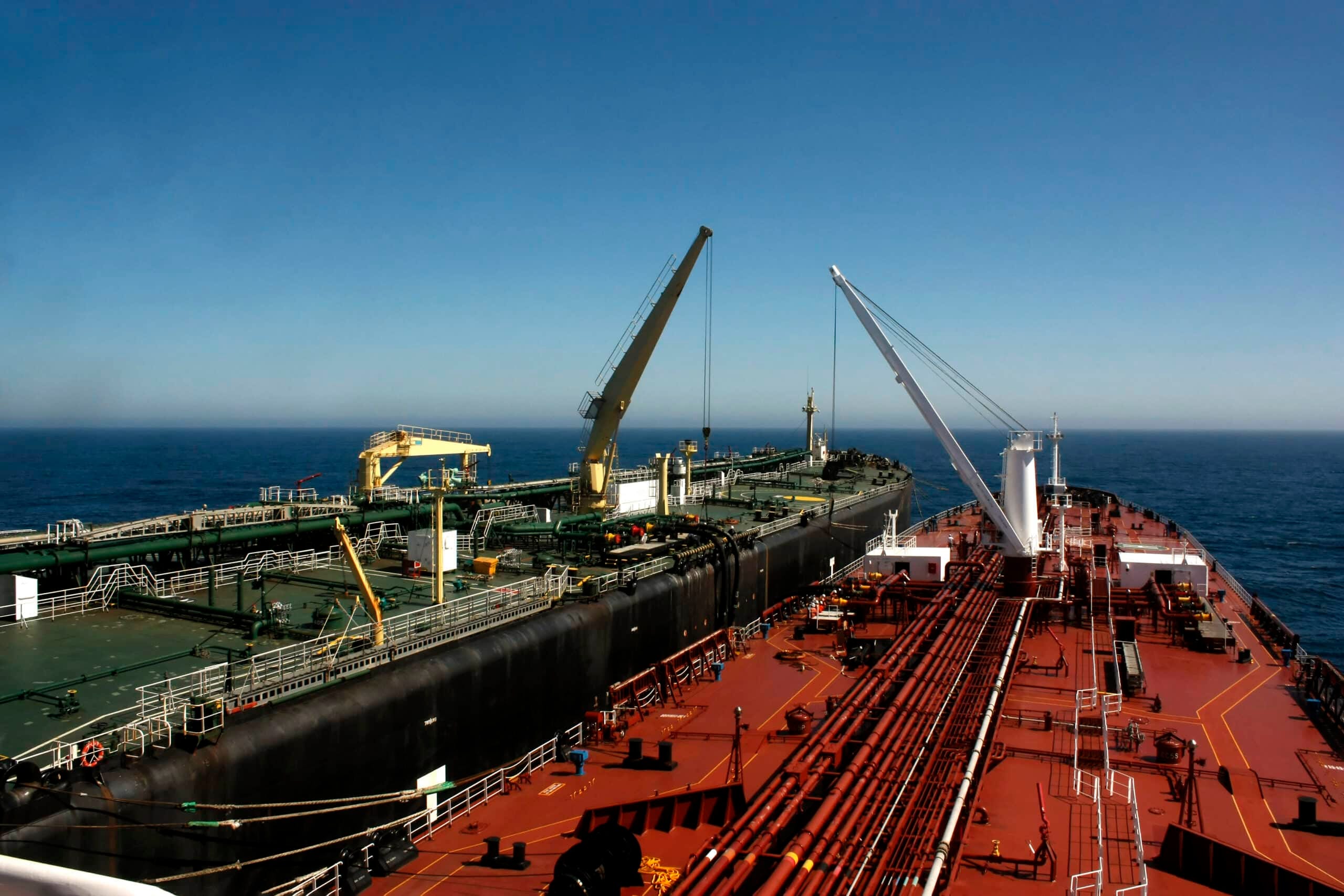
Caine could have said “any Iranian-flagged vessel.” Bounded, legally contestable. He said “or any vessel.” That phrase, if applied in its broadest reading, removes the flag restriction and claims US enforcement authority over any tanker, bulk carrier, or container ship on the high seas based on US cargo suspicion. Whether the phrase is applied in that broadest reading is the central question the next few weeks will answer. Several readings remain open. It may be a settled rule of engagement, a deterrence signal directed at Dark Fleet operators, or an operational posture already executed in limited form. The M/T Tifani seizure on 21 April in the Indian Ocean, 2,000 miles from the Gulf, suggests elements of the third reading are already in motion. Three US carriers in the Middle East for the first time in decades. Paparo’s Indo-Pacific area of responsibility explicitly named. None of this settles the question. It raises it.
This is Fishman’s thesis in its physical form. Financial arsenal has crossed into open-ocean enforcement. Singapore’s own jurists laid out the governing framework with precision long before the current crisis. Singapore Ambassador Tommy Koh, presiding over the third UN Convention on the Law of the Sea (UNCLOS III) at Montego Bay in 1982, established that rights and obligations under the Convention go hand in hand. States that expanded their territorial seas to twelve nautical miles cannot simultaneously reject the obligation not to hamper or suspend transit passage. That foundational principle is the one perhaps being tested now.
The blockade of Iranian ports has a defensible foundation in the law of naval warfare. Extraterritorial interdiction of third-party vessels on the high seas based on cargo suspicion sits in significant legal tension with established interpretations of transit passage under the United Nations Convention on the Law of the Sea and with the customary law the US itself has enforced for four decades through Freedom of Navigation Operations, the programme of deliberate transits the US Navy has conducted since 1979 to physically assert that transit passage rules apply to everyone, most visibly against Chinese claims in the South China Sea. The US has not ratified UNCLOS but accepts transit passage as binding customary international law. The 24 April “Caine doctrine” contradicts that reading in the very strait regime the US Navy has most often invoked it to protect.
If the broadest reading holds, every major power with naval assets could cite American action in the Gulf as legal cover for chokepoint controls elsewhere. The phrase, operationalised in that form, would bypass the compliance machine that took two decades to build. Every bank trade finance desk, Protection and Indemnity club and Lloyd’s syndicate would operate under a new condition.
The significance for chokepoints is direct. The Hormuz blockade may no longer be local to the Gulf. The possibility now on the table is that authority over transit increasingly means authority over the flow.
Hormuz is today a laboratory. The signals to watch elsewhere.
Hormuz is where the toll architecture, the Dark Fleet reorganisation, and the naval enforcement doctrine are being prototyped simultaneously. Tehran has the toll mechanism operational, with the first revenues collected this week. Washington has the counter-enforcement doctrine operational, with thirty-four vessels turned back. Both sides have set precedents. Precedents travel.
There is no direct evidence that any other chokepoint is the next test case. What we have are signals worth watching at three other chokepoints, each for a different reason. Clear-eyed signal-scanning is the discipline. Prediction is not.
Malacca carries the structural profile that makes it the most natural signal for those of us here to watch in Southeast Asia. Thirty per cent of global trade. Seventy-five per cent of China’s seaborne crude. Two hundred ships a day, double the Hormuz traffic. The narrowest point is less than two nautical miles, ten times narrower than Hormuz, a comparison Home Affairs Minister Shanmugam drew on 13 April. On 22 April Purbaya floated a transit toll, citing Iran’s new Hormuz transit toll law by name. Within thirty-six hours Sugiono formally denied it at foreign minister level. Malaysia’s foreign minister aligned with Singapore. Thailand’s deputy prime minister fast-tracked a land bridge proposal. The littoral states closed ranks quickly on preserving transit passage, which is the correct reading of the immediate episode.
The longer signal is the US-Indonesia Major Defense Cooperation Partnership signed 13 April, with codevelopment in maritime, subsurface and autonomous systems, plus the Operationalizing US Overflight proposal. That package is intelligence, surveillance and reconnaissance architecture. Whether it is ever deployed under a blockade enforcement logic is a question of future US policy choices, not of present intent. Capability and use are separate questions. Both warrant watching.
The Taiwan Strait carries a different signal. If Washington extends the “any vessel” doctrine to Taiwan Strait transits, Beijing has a procedural mirror move immediately available. The US said “any vessel we suspect.” China can say “any vessel we are inspecting for maritime safety compliance.” A closely parallel legal logic. Washington’s action creates a precedent that Beijing could cite. Beijing’s structural preference remains for UNCLOS and the International Maritime Organisation to hold. The procedural mirror is what China reaches for only if the US forces that choice.
The Bab el-Mandeb carries the asymmetric signal. The Houthis have demonstrated that a non-state actor with anti-ship capability can shape chokepoint traffic at negligible cost. Hegseth on 24 April called on European allies to take a larger role in Hormuz. That signal reaches the Red Sea too.
The common thread is that chokepoint control has ceased to be a shared public good administered under UNCLOS. Iran weaponises chokepoints through tolls and mines. The US response has introduced a parallel enforcement logic, operating through naval interdiction and suspicion-based authority. China is positioning for a procedural mirror move if Washington forces the choice. The Houthis show what an asymmetric actor can do on a small budget. Fishman’s financial chokepoints thesis now extends to physical maritime chokepoints. The arsenal has crossed into salt water.
Four things to watch. The ninety-day window.
In “Reading Chokepoints while looking out at Malacca” on 23 April I named four things to watch over the next ninety days. Two days on, each has moved.
The Overflight Letter of Intent has not been formalised. The 24 April doctrine has raised the stakes on whether it is.
The Malacca toll proposal was floated by Purbaya and formally denied by Sugiono within thirty-six hours. The commercial propagation route is closed for now.
The Islamabad negotiation text on Hormuz governance is not yet drafted. It now runs through a Tehran leadership that has publicly consolidated.
The International Maritime Organisation’s 36th Extraordinary Session remains the venue where a workable safe corridor mechanism either emerges or does not.
The arc is ninety days faster than it looked at the start of this week.
Singapore’s position, and why it holds
Singapore sits on the one chokepoint where the US does not have uncontested primacy. The Malacca and Singapore straits are bounded by Indonesia, Malaysia, Thailand, and Singapore. They are not patrollable by a single external power without local consent. Seventy-five per cent of Chinese crude flows through them. Japanese, Korean, and Taiwanese energy security flows through them. The rules that protect transit passage here protect the core of the Asian trading system.
Balakrishnan’s remarks at CNBC’s Converge Live on 22 April were an unambiguous restatement of the position he had set out in Parliament on 7 April. Transit passage is guaranteed for everyone. Singapore will not participate in any attempt to close, interdict, or impose tolls. Singapore will be useful and will not be made use of. Quoting Lee Kuan Yew, Balakrishnan added the canonical line: “We will refuse to choose. The way we conduct our affairs is we assess what is in Singapore’s long-term national interest.” He anchored it to the 1973 episode, when Lee Kuan Yew called in the oil majors, told them Singapore would pay full market price for whatever it needed and take its share of rationing. Not panicking in a crisis is worth a lot. Singapore’s refining and petrochemical sector took off from that moment.
The parallel holds. Maintain reliability. Price everything fully. Refuse to participate in closure, interdiction, or tolls. Negotiate actively on substance. The rulebook that protected free maritime commerce after 1945 is now being stress-tested by the state that did most to enforce it. Someone else has to hold the thread until it is rebuilt. That someone else, in the first instance, is Singapore.
Singapore’s practical posture should now be threefold. Defend transit passage without exception. Avoid operational entanglement in any interdiction architecture. Build a coalition of maritime trading states around flag-state authority, port neutrality, and assured supply. The immediate work is quiet diplomacy with Malaysia, Indonesia, Australia, Japan, Korea, and the major flag states.
As for Purbaya, Singapore should assume the proposal was serious enough to answer, but not yet settled enough to escalate.
References
Edward Fishman, Chokepoints: American Power in the Age of Economic Warfare (Portfolio, 2025).
Edward Fishman, “How to Fight an Economic War: A Field Manual for a Ruptured World,” Foreign Affairs, 23 April 2026. https://www.foreignaffairs.com/united-states/how-fight-economic-war-fishman
Ray Ferguson, “A Hormuz Chokepoint Precedent?” Infinite Horizons, 11 April 2026.
Ray Ferguson, “Reading Chokepoints while looking out at Malacca,” Infinite Horizons, 23 April 2026.
Pentagon briefing transcript, Secretary Hegseth and Chairman Caine, 24 April 2026.
Ray Ferguson is a chairman and international banker with 35+ years of leadership across Asia, the Middle East, Europe and the Americas. Former CEO of Standard Chartered Americas, CEO of Standard Chartered Singapore and SEA, UAE and Oman, and Deputy CEO of Bank ABC, Bahrain. Chair of insurer Singapore Life and 36ZERO Marine Group. Singapore citizen, ocean sailor, board mentor, and author of the memoir Infinite Horizons: Seasons in the Sun: A Memoir of Leadership and Life. He writes on geopolitics, markets and leadership.
Join the conversation
Comments and replies take place on Substack, where Ray reads and responds.
INFINITE HORIZONS
Get each edition by email
Free. Delivered by Substack. Unsubscribe from any email.
Infinite Horizons is published by World Scientific and available now.
Buy the book

