China filled the tank
· 7 min read · 1 comments
The oil spike is over. The wealth it moved is not coming back. It went to whoever held a substitute, and China spent twenty years building one.
Infinite Horizons · Signal Stack · Ray Ferguson · Singapore · Tuesday, 30 June 2026
Brent is back where it began.
The barrel that touched nearly $120 at the height of the war now trades in the low seventies, close to its level the day before the first strike. Traders who braced for $200 have moved on, and a maritime analyst last week called the disruption that pushed prices past $120 “well and truly over.” The market has filed the episode under closed.
What happened? Well the value that left the strait went somewhere. It was collected, and the receipts have names on them. The useful question for an Asian boardroom this week is the one the relief rally skips. When the world’s most important chokepoint is marked down, who gets paid.
The winners held a substitute
A New York Times analysis compared the oil and fuel shipped during the war with the same months a year earlier. The biggest beneficiary was the United States, exports up and revenue higher by about $50 billion. Russia came next, exports steady and revenue up by more than $15 billion. Every Persian Gulf producer saw its export volumes fall.
The ones that still gained were the producers that could leave the chokepoint out of the journey. Saudi Arabia moved barrels west through its Red Sea pipelines. Oman sat outside the strait by geography. Iran, holding the tollgate, took more revenue on less oil. A Reuters analysis of the same period put the divide in numbers, with Iran’s notional oil revenue up 37% and Oman’s up 26%, while Iraq’s fell about three-quarters and Kuwait’s by a similar margin.
Iran collects beyond the gate as well. The Institute for the Study of War reads it as going to Doha this week to press for the release of its frozen assets, the provision it wants most from the deal.
So one state draws rent from the strait and relief from the table in the same month.
The pattern across the rest is plain. Whoever could route around the strait, or sat beyond it, or owned the gate, collected. Whoever depended on the single lane and held nothing in reserve, paid dearly.
The adult in the room
The real winner planned for this. China spent years filling its tank while Washington ran its own down.
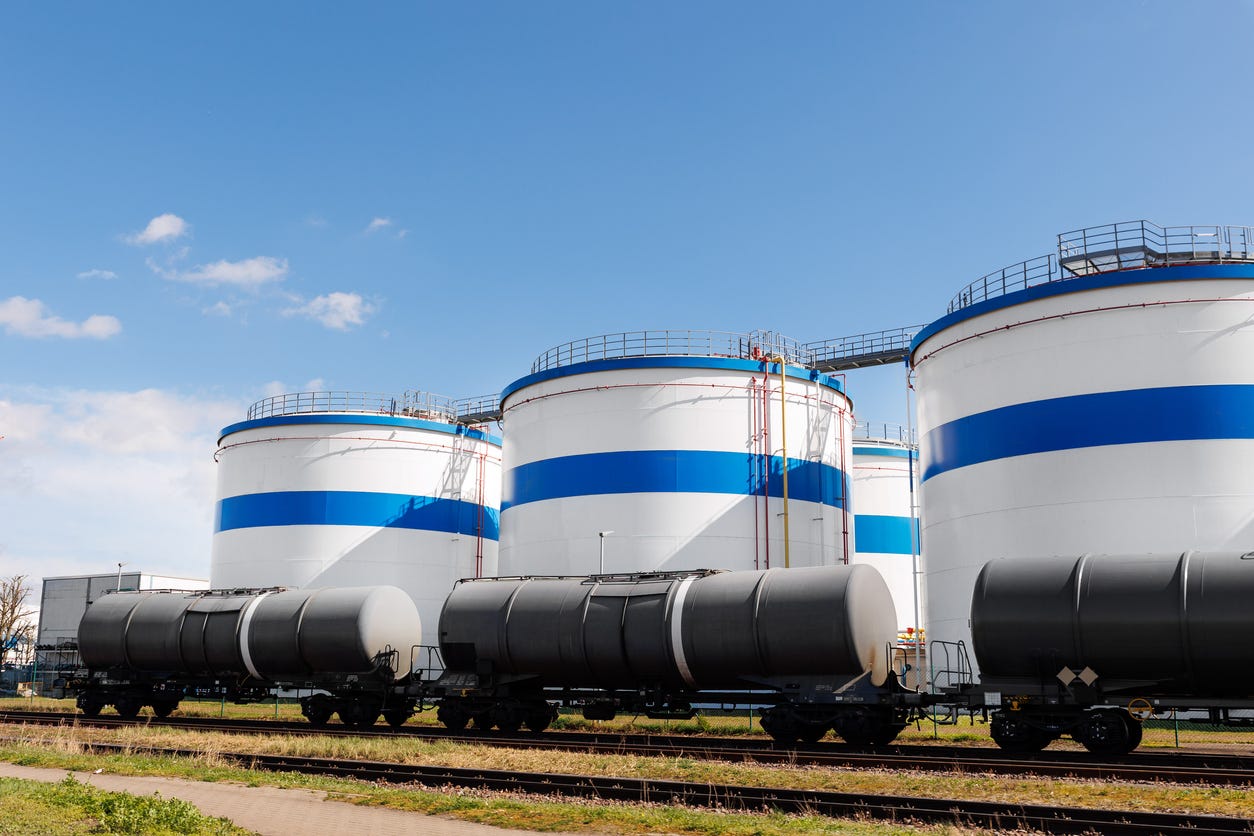
By early 2026 it held the largest oil stockpile in the world, government and commercial barrels together, on the order of 1.2 to 1.4 billion, roughly a hundred days of seaborne import cover, and it built most of it from discounted Iranian, Russian and Venezuelan crude bought below the market price. Energy-sanctions trackers reckon about 83% of its 2025 import growth went straight into storage. Little of it ever reached the economy. When Brent touched $118 in March, the price inside China moved at about a fifth of the volatility of the world market. The buffer did exactly what it was built to do.
When the strait broke, Beijing met what the International Energy Agency ranked the largest supply disruption in the history of the oil market simply by buying less and in doing so limited upward demand driven prices globally.
Imports fell from about 11 million barrels a day before the war into the high-7-million range by May, with some seaborne trackers lower still, a cut one bank ranked among the largest single offsets to the shock, larger than the coordinated reserve releases of the United States, Europe and Japan combined.
Some of that drop reflects a softer economy and the unstoppable switch to electric vehicles, and the buffer is what gave Beijing room to choose how far to cut. A Bloomberg Intelligence analyst said China was one of the single biggest reasons oil never spiked. By trimming its own demand, the world’s largest importer capped the world’s price. It steadied the market it lives on, and it did so without firing a shot or throwing a switch.
The restraint is the win.
China had no need to weaponise the yuan or send ships and subs to force the lane, because the reserve had already done the work.
There is a hard irony in it for anyone who watched the sanctions machine get built. The campaign that drove Iran, Russia and Venezuela to sell their crude cheap, and to sell it to China, is the same campaign that let China assemble the cheapest and largest oil buffer on earth. The weapon financed the shield. Beijing has been super canny, and it has been patient, and the two together bought it a quiet quarter while the rest of the importing world paid up.
Set that against Washington. The United States met the war with a reserve already run low, sitting well below its 714-million-barrel capacity after the 2022 drawdown, and it kept drawing on it, the export surge pulled from inventory with little new production behind it.
Two great powers ran opposite reserve strategies into the same crisis. The one that filled the tank when oil was cheap is the one that sits calm while the other watches the gauge. I made the case before that an emptied reserve is itself a depreciating asset, in The Strategic Petroleum Reserve is the Next Depreciating Asset. China is the photographic negative of that argument.
The long game, and its limit
The reserve is the near-term half of the plan. The far side is the map. For more than a decade Beijing has been laying overland routes that take the sea out of the journey wherever it can. This week it opened a rail line running 5,420 kilometres from Qinghai in western China to a freight terminal on Turkmenistan’s Caspian coast, one more strand in a Central Asian network that already reaches Kazakhstan and Uzbekistan. State media framed it as resilience against shipping risk. It sits alongside the gas pipelines from Turkmenistan, the crude line from Kazakhstan, the oil and gas pipelines across Myanmar that let tankers offload short of the Malacca Strait, and the China-Kyrgyzstan-Uzbekistan railway now moving from ceremony into funded construction.
A country that thinks in five-year plans has spent twenty years buying its way off the water.
The hedge is real and it is partial though. The new train is loaded with appliances and auto parts. Crude still moves by sea, where pipelines carry a useful share of China’s gas and only a slice of its oil, and roughly 80% of China’s imported crude still passes through the Strait of Malacca. That is the figure that keeps Beijing honest. It can put a container on a train through Kazakhstan. Its energy still rides the sea lanes. So China defends the maritime rules at the narrow water even as it builds the roads that might one day let it care less. The strait that still carries its oil is the one it needs governed, open and free, and it runs to two nautical miles at the point that matters most.
What the strait taught
That last figure is Singapore’s strait. A depreciating chokepoint rewards two things, a substitute and patience. The United States had shale and the capacity to export it. Russia had buyers with nowhere else to go. Saudi Arabia had pipelines to a second sea. Oman had its place on the map. China had the reserve, the discipline to wait, and twenty years of track and pipe pointed away from the water. Each of them ended the quarter among the payees.
The ones who paid were tied to a single lane with nothing held back. Most of them are in Asia, which takes about 84% of the crude that moves through Hormuz. China banked the raw input, the crude it can refine on its own schedule.
Singapore lives a step downstream, turning Gulf barrels into the diesel and jet the region runs on, so when the crude is tight the cost passes through its refineries to the customers beyond. Australia is one of them, importing about 80% of its fuel from Singapore and its neighbours, and the energy-trade agreement the two signed during the war is the buffer being built in real time.
For Asia the lesson reads in a line. Build the buffer and the map before the day you need them.
Storage measured in months, suppliers spread across more than one gulf, routes that do not all funnel through the same gate, and a multilateral claim on the chokepoints themselves are the instruments that move a country from the payer’s column to the payee’s.
China showed what a generation of that work buys when the water finally closes.
Singapore has already begun the same work in its own form, with the crisis committee it stood up and the energy deals it signed through the war. It cannot lay a continental railway out of the Gulf, so its buffer is the role it already plays, the place where the region’s supply is organised before scarcity turns to panic.
Its substitute is decades old accumulated trust, contracts, tanks and timing.
The strait at Hormuz has already shown the rest of the map what a marked-down chokepoint looks like, a point I made when this began in A Hormuz Chokepoint Precedent.
The question it leaves on every Asian board table is the plain one. When the next lane breaks, which column are you in.
Ray Ferguson writes the Infinite Horizons Substack. Signal Stack covers geopolitics and markets. Tech Stack covers AI and technology. Full archive of previous Signal Stacks. Ray is a chairman and international banker with 35 years of leadership across Asia, the Middle East, Europe and the Americas. Former CEO of Standard Chartered Americas, CEO of Standard Chartered Singapore and SEA, UAE and Oman, and Deputy CEO of Bank ABC, Bahrain. Chair of insurer Singapore Life, 36ZERO Marine Group, and ESGpedia, Asia’s leading ESG data and technology company. Singapore citizen, ocean sailor, board mentor, and author of the memoir Infinite Horizons: Seasons in the Sun: A Memoir of Leadership and Life.
Join the conversation
Comments and replies take place on Substack, where Ray reads and responds.
1 comments so far.
INFINITE HORIZONS
Get each edition by email
Free. Delivered by Substack. Unsubscribe from any email.
Infinite Horizons is published by World Scientific and available now.
Buy the book