The Indispensable Middle
A leading scholar says the middle-power moment is over and hedging is delusion. Wall Street chief Dimon agrees and names Europe. The case is unfinished and not so binary.
· 8 min read
Infinite Horizons · Signal Stack · Ray Ferguson · Singapore · 28 June 2026
A longer read than usual. I started thinking about this one yesterday morning and the argument kept opening out….
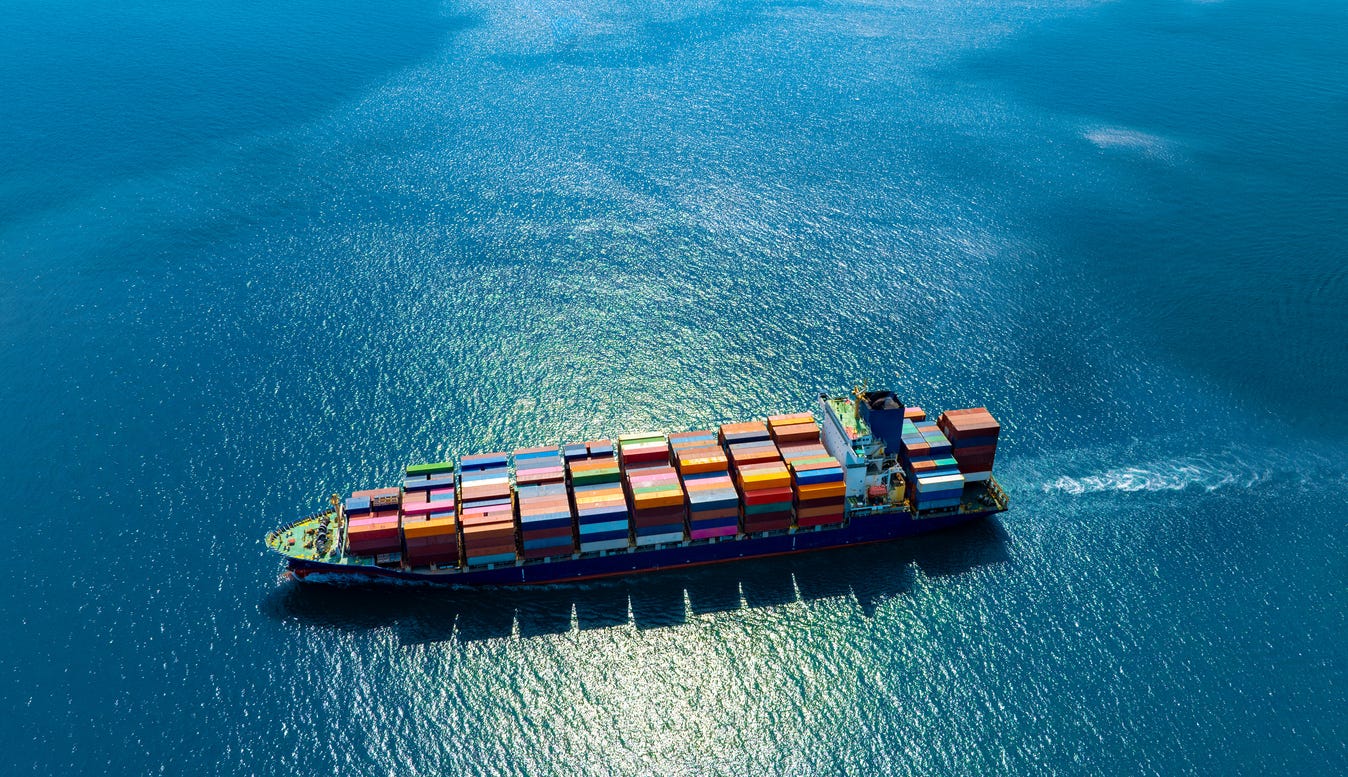
In a single week, one small country’s flag was challenged at two of the world’s most contested straits. At Hormuz, an Iranian drone hit a Singapore-flagged container ship, the Ever Lovely, as it left the Gulf, an attack Singapore’s Maritime and Port Authority condemned as unprovoked and a breach of international law. Off Taiwan, a Chinese coast guard cutter hailed another Singapore-flagged vessel and demanded its papers.
Four thousand miles apart, the same flag, the same message from a larger power. This water is ours to control, and your passage is ours to grant.
The flag happened to be Singapore’s this time, but it could have belonged to any middle power whose supply lines run through straits it does not own.
It is the right week to read Michael Beckley, the Tufts political scientist and among the most rigorous defenders of American primacy, who argues in Foreign Affairs that the age of the middle power is ending and that small trading states had better stop pretending otherwise and choose a side. The case I’d argue is unfinished and not so binary.
The case he makes
Beckley’s argument deserves to be met at full strength. Across two books he has argued that gross size misleads and net power decides, that once a country’s internal burdens are subtracted the United States towers over China by margins the headline numbers hide, and he advises the Pentagon, so this is the establishment’s sharpest case.
For decades, he writes, middle powers flourished under three conditions: American security cover, a globalising economy, and growth fast enough to close the gap. All three are fading. Protection has narrowed and turned transactional, globalisation has hardened into a contest over minerals, tariffs, chokepoints, and growth has slowed.
What looks like a new multipolar age, in his reading, is a world growing more hierarchical, with two powers holding a structural power no coalition of middle states can assemble.
Niche leverage, a key port, a chip fab, a strait, lets a country disrupt a system. It does not let a country command one. The instruction follows hard. Choose the great-power system that best shelters you from your gravest threat, build national strength, and bargain for influence inside it. Hedging, in this account, is a luxury of calm times, and calm has gone.
The banker’s version
Beckley has company from a quarter that knows the plumbing well. Asked at the Council on Foreign Relations this week about Carney’s call for the middle powers to band together, Jamie Dimon called the idea “a fantasy,” and said the experiment already exists and is called Europe.
His evidence is the capital base. Europe’s economic weight has slipped from about ninety per cent of American output to seventy, its largest exchanges are worth a few trillion dollars each against a New York market above sixty trillion, and capital keeps crossing the Atlantic toward the deeper pool. A bloc can be large on the map and still lose the capital that decides who grows. From my own years inside dollar markets the gravity is real: the depth of the American capital market is itself an instrument of power, the same the economic-warfare literature traces through dollar clearing and sanctions.
This week handed Beckley his evidence. China’s move off Taiwan drew a joint Western objection that Beijing waved away, while Iran’s grip on Hormuz drew an American airstrike that actually moved ships, and Iran has now stood up a formal Persian Gulf Strait Authority that vets and permits the vessels allowed to pass, an administration in the literal sense.
A statement and an airstrike are different weights, and only one of them turns a hull around. His hardest claim, that niche leverage falls short of command, is on the record this week in salty water.
Where the argument turns
The analysis is strong, but the choice it offers is too narrow.
Beckley sets the options as alignment or standing alone, and a whole class of trading states has spent two generations in a third position his frame does not name, running on three rules.
Security alignment is the part you do not substitute, anchored where the threat requires it. Economic and technological inputs you keep deliberately substitutable, with more than one supplier of energy, technology and capital. Leverage comes from controlled indispensability, owning nodes the patron needs while holding the inputs loosely enough that no one can switch you off. The shape is concrete.
When Washington pulled its leading AI models from foreign nationals this month, the answer in Asia provokes a situation keen to run almost at par open-weight models in-country, on local cloud, inside the buyer’s own perimeter. A country that can source its fuel, its chips and its compute from more than one place keeps its patron earning the relationship, and is worth more inside the alliance.
Beckley half-concedes the point. His own prescription tells middle powers to make their dependence reciprocal, to turn a port or a factory or an army into a chip the patron consults before it commands. Japan is his model, indispensable to American power while leaving the lead to Washington.
The states that weathered this decade best never tried to be a pole. They aligned, and made themselves the node the pole cannot do without. South Korea and Australia build national strength inside the alliance. The Gulf monarchies spread their suppliers, a lesson the war drove home when even the UAE needed France, South Korea and an Israeli battery to blunt Iran’s missiles, and the Economist now counsels them to build pipelines and shared ports that make Iran’s chokehold a wasting asset.
Singapore prices everything fully and holds reliability as its national product, a posture canny in the old Scots sense, shrewd about price and slow under pressure. Foreign Minister Vivian Balakrishnan caught the mood in one line: a country that will be useful, and it will not be made use of.
Many straits, two switches
Set Beckley beside the other writer input this signal stack series keeps returning to. Edward Fishman’s account of economic warfare describes the arsenal, the way states weaponise the plumbing of the world economy, dollar clearing, shipping lanes, export controls, which I read against the Malacca backdrop in Signal Stack “Reading ‘Chokepoints’ while looking out at Malacca”.
Fishman shows how many weapons now exist, Beckley how few hands can hold enough to matter, and the task that falls out is to own enough of the narrow points, the port, the refinery, the data centre, the flag on enough hulls, that the power you align with needs you, while keeping them diversified enough that the other side cannot switch you off. Lynn Kuok of Brookings warned that Hormuz is a warning for the Indo-Pacific, that weaponising one strait teaches every bordering power the trick. The deepest waters carry more than cargo. George Yeo, Singapore’s former foreign minister, argues the South China Sea is contested in its lower latitudes because it shelters China’s ballistic-missile submarines, the survivable second strike on which its deterrent rests.
Control of that strait reaches to who can hold a retaliatory force at risk, the clearest sign that authority over transit has become a great-power instrument.
There is a catch in his prescription.
The patron he tells you to choose is the same one that bombed Iran to reopen a strait on a Thursday and weighed trading away a Taiwan arms package to Beijing on another, a pattern I traced in Signal Stack “The Week the Leverage Ran Out”.
Alignment is the right counsel, and the guarantor now prices its guarantees, so the hard test comes in a crisis. When a patron demands exclusivity, secondary sanctions, wartime export controls, one technology stack, diversification will not let a small state defy it, and Japan and the Netherlands complied when Washington tightened chip controls on China.
The honest claim is narrower and still worth a great deal. Managed dependence does not buy a veto in the storm. It buys the terms. The state that kept more than one supplier, held reserves and built valued vital nodes pays a lower price to comply and arrives with something to trade, and that work is done in the long grey-zone years that precede the crisis.
What it means
For the middle trading states the work is concrete: anchor security where the threat requires it, keep more than one source of energy and technology and more than one route for the cargo, and be the node the larger power cannot route around.
The same discipline now sits in front of every board in Asia, because a company faces the smaller version of the state’s problem. A firm that runs on one cloud, one chip line, one model provider or one dominant export market holds a switch somebody else can throw, and this month’s loss of foreign access to American frontier models, which I wrote about in Tech Stack “The Switch Somebody Else Holds”, showed how fast it moves.
The board’s task mirrors the state’s. Keep the alignments that are genuinely fixed, the regulator, the reserve currency, the security umbrella the business sits under. Make the operational inputs plural by design, a second cloud in region, a second supplier qualified, a model that runs inside your own perimeter. Own something a key partner cannot easily replace, the refinery, the port, the data-centre corridor, the cross-border power and digital links a region routes through, so that when terms are dictated you are dear enough to keep.
Beckley is right that the easy globalisation years are over and that standing alone is a fantasy.
The answer for a country and for a company is the same, a dependence priced on both sides, dear enough to whoever you rely on that it pays to keep you, and managed enough on your own side that a squeeze costs you less than your competitors.
That is the oldest discipline the open economies have, and the week at two straits is the reminder to practise it.
Ray Ferguson writes the Infinite Horizons Substack. Signal Stack covers geopolitics and markets. Tech Stack covers AI and technology. Full archive of previous Signal Stacks. Ray is a chairman and international banker with 35 years of leadership across Asia, the Middle East, Europe and the Americas. Former CEO of Standard Chartered Americas, CEO of Standard Chartered Singapore and SEA, UAE and Oman, and Deputy CEO of Bank ABC, Bahrain. Chair of insurer Singapore Life, 36ZERO Marine Group, and ESGpedia, Asia’s leading ESG data and technology company. Singapore citizen, ocean sailor, board mentor, and author of the memoir Infinite Horizons: Seasons in the Sun: A Memoir of Leadership and Life.
Join the conversation
Comments and replies take place on Substack, where Ray reads and responds.
INFINITE HORIZONS
Get each edition by email
Free. Delivered by Substack. Unsubscribe from any email.
Infinite Horizons is published by World Scientific and available now.
Buy the book