Operation Economic Outcast Reaches Singapore Shores and Stops Short of Beijing
Treasury has named Azure Shipping and other Singapore firms, moved on an Egyptian bank’s Dubai branches, and left the Chinese banks alone before Xi arrives stateside
· 8 min read
Infinite Horizons · Signal Stack · Ray Ferguson · Tokyo · 5 September 2026
A bank in Dubai finds out
On 28 August the US Treasury proposed a rule barring American banks from any transaction involving the Emirati branches of Banque Misr, one of Egypt’s largest. Treasury says it identified 103 potential front companies that moved $1.8 billion through those accounts between January 2024 and June 2026, and it moved against the general manager of Bank Melli’s Dubai branch.
Scott Bessent’s statement was addressed past Cairo and past Dubai: “Iran’s enablers cannot continue to enjoy access to the U.S. dollar.”
Treasury did it again on Friday, designating Istanbul-based Golden Global Bank and two subsidiaries for providing correspondent banking access to the Quds Force. Treasury says the bank existed to move Iranian oil revenue out of China into Türkiye, where it was converted into cash and gold. Counterparties have until 19 September to wind down.
An Egyptian state bank with Emirati branches, then a Turkish investment bank moving Chinese money.
Four jurisdictions, one lever.
These are the first bank-facing actions of the campaign Treasury has named Operation Economic Outcast, and the choice of target tells you more than the size of it or the entities.
An earlier Signal Stack I penned argued that Bessent was buying time in the oil market and would pay for it later.
The financial campaign is the other half of that trade.
The instrument, and why it works so quickly
The mechanism is a Patriot Act finding that a foreign institution is a primary money-laundering concern. What follows is the loss of correspondent access.
Anyone who has run dollar clearing understands why that lands harder than a designation list. A listing tells a bank who it may not deal with. Losing correspondent access tells a bank it can no longer settle in the currency its customers invoice in. The compliance response is immediate and it overshoots, because the cost of an error is existential and the cost of over-caution is a lost client.
That overshoot is the point. Treasury needs every bank in the region to assume it might be next in line.
The ordered queue
Guney Yildiz, writing in Forbes, identifies a remedy window giving each country a defined timeline to change behaviour, a queue that runs first through the most replaceable nodes in the network, and guidance putting a sanctions price on Iran’s Hormuz toll collectors.
The queue is the part worth sitting with. The opening moves are a branch manager in Dubai, a front company in Hong Kong, a correspondent account in a mid-tier centre. Each can be removed at almost no cost to the system. The largest buyers of Iranian crude sit further back.
A campaign sequenced this way generates early wins that are real and cheap, and postpones the expensive decision. The order is the message.
Where the queue stops
Note what the Golden Global designation says. Treasury named China as the origin of the money and designated a bank in Türkiye.
China buys the overwhelming majority of Iran’s exported oil. Treasury has sanctioned Chinese teapot refineries that take the crude at a discount and has left the Chinese banks that settle it alone. Asked directly at the launch whether Chinese banks would be targeted, Bessent said no one is above the reach of US sanctions. Asked when Iran’s largest trading partners might face secondary sanctions, he answered with a question of his own: “Why would I want to blow up the global financial system?”
That is the campaign’s unsaid boundary, stated by the man who drew it. At the G20 he softened further, saying Washington and Beijing have more in common than differences on Iran, that China takes half its energy from the Gulf, and that a solution is incumbent on China. Xi arrives in Washington late this month.
At the North Carolina meeting this week, China dissented from the Strait of Hormuz paragraph of the G20 statement, along with three others covering trade imbalances, IMF surveillance and sovereign debt restructuring, so the meeting closed with a chair’s statement and no communiqué. Beijing and Moscow had already vetoed a Bahraini resolution on reopening the strait at the Security Council in April. The European Union has formally joined the campaign and South Korea is weighing a military contribution.
The Emirates moved first among the Gulf states, suspending all trade and financial ties with Iran on 20 August after Iranian missiles struck at Emirati shipping, citing regional escalations.
Bessent said the timing was no coincidence. Analysts noted that halting direct trade may do little about oil revenue reaching Tehran indirectly.
The allies are signing.
The two governments whose agreement would actually settle Hormuz are not.
Tokyo pays the bill
93% of Japan’s crude arrives through the Strait of Hormuz. That single figure explains the whole of Tokyo’s position.
When the strait effectively closed, Japan began releasing 80 million barrels from reserve on 16 March, around 45 days of domestic demand. It could afford to, holding roughly 470 million barrels across national stockpiles, mandatory private reserves and a small arrangement with Gulf producers, about 254 days of consumption and one of the deepest buffers any country has built. Six months on, it is being spent.
Writing this damp Saturday from Tokyo, the striking thing is how quiet the official position is. Japan has the largest exposure of any advanced economy to the outcome and the least ability to influence the governments that will determine it. Seoul is publicly weighing a military contribution. Brussels has signed. Tokyo is drawing down the tank and saying very little.
A buffer that deep is a real strategic asset, and a finite one. A country that spends it while others swither ends with less room than it started with.
Singapore is already on the list
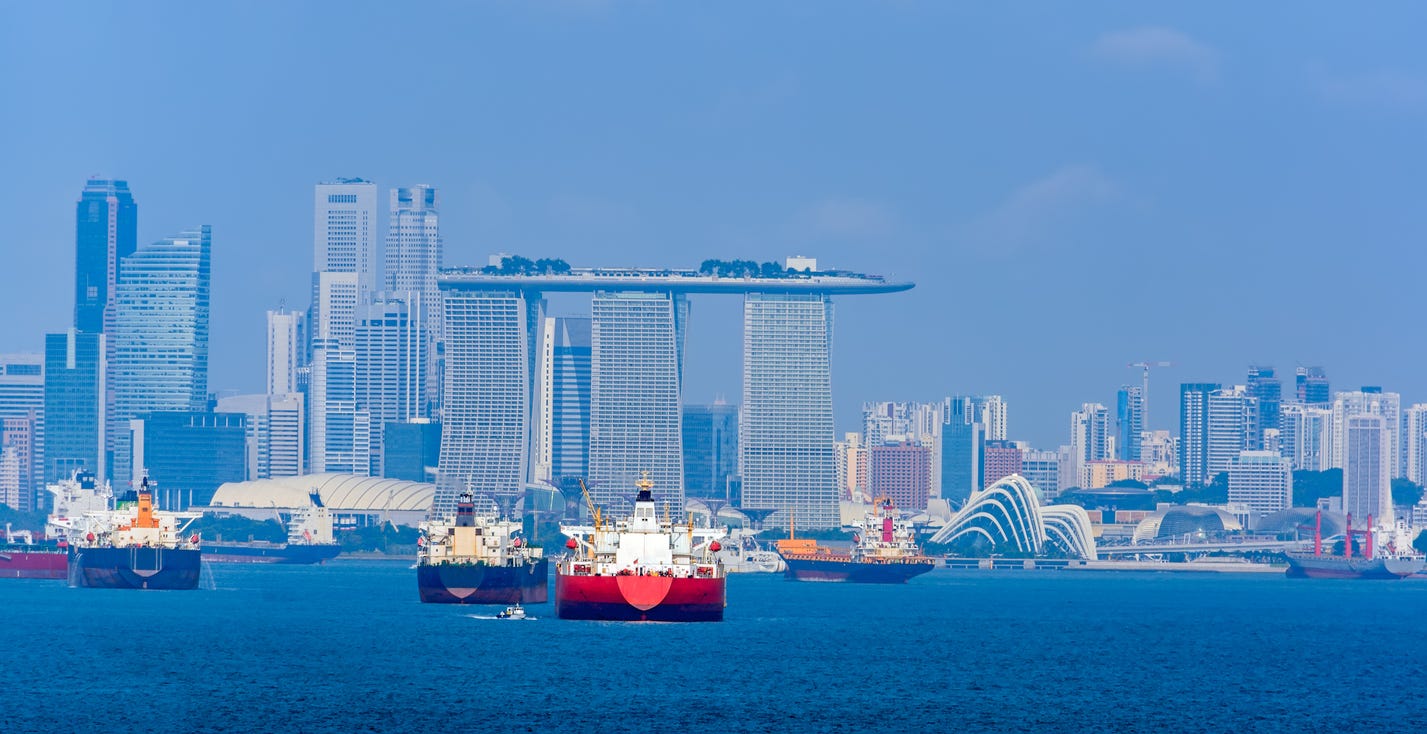
The 24 August package sanctioned nearly 60 entities, vessels and individuals, and Singapore is on the list by name.
OFAC designated Azure Shipping Pte Ltd of Telok Blangah Road for arranging ship-to-ship services with the National Iranian Tanker Company, along with Arc Chartering of Harbourfront Centre, Wellbred Capital, and the Singaporean former owner of Azure. The same action reached a bunkering network operating out of Hong Kong and Dubai, which is the part a Singapore reader should sit with, given what this port does for a living.
The chokepoint guidance matters more, and it is harsher than most summaries suggest. Iran established the Persian Gulf Strait Authority in May to run a permit system requiring vessels to file a transit request before entering the strait.
OFAC designated it on 27 May under the terrorism authority. On 29 July it added the Persian Gulf Marine Insurance Company and HormuzSafe Marine Services Authority under a separate financial-sector authority, describing an IRGC-backed scheme selling mandatory cover against risks Iran itself creates, with premiums payable in digital assets. The same action blocked eight shadow-fleet tankers and their Hong Kong and China-registered managers. The alert was updated again on 24 August.
Read it carefully. Exposure arises from accepting insurance or services from these entities, and from responding to their demands for information in exchange for guarantees of safe passage, whether or not any payment is made.
No money needs to change hands.
Sanctions counsel have noted that Treasury’s use of the terrorism authority for the strait authority removes a knowledge element that would otherwise limit how far derivative liability travels, so a charterer can acquire exposure through what an operator did three contracts away. Maritime intelligence providers have reported individual transits priced as high as $2 million, settled in yuan.
That leaves an owner with a dilemma and no clean answer. Take the northern route, deal with the strait authority, and carry escalating US sanctions risk for your board. Take the southern route off Oman, decline to deal, and carry the risk of an Iranian missile. Not easy.
Singapore’s position on this needs no hedging. Freedom of navigation through international straits is settled law, and Tommy Koh chaired the conference decades ago that settled it. An authority invented in May 2026 to sell transit permits has no standing under the Convention. Tehran’s security officials have been explicit about the consequence of compliance with Washington, with Mohsen Rezaei warning that “not a drop of oil will leave the Persian Gulf” if Iran’s neighbours join the campaign.
For board of finacials and corporates here the practical exposure is narrower than the headlines and harder to see. It sits in the counterparty two steps down a trade finance chain, in a vessel’s prior port calls, in an insurance placement, and in whether anyone in the organisation has answered a question from an entity that did not exist eighteen months ago.
What this actually is
Operation Economic Outcast is looking like a well-built instrument aimed at the parts of the network that can be removed without argument. It will produce a steady run of designations, each defensible, each cheap: Cairo one week, Istanbul the next. Fortune’s assessment after the first week was that the world had largely shrugged.
The UAE has suspended trade with Iran and Bessent says the timing was no coincidence. That is a real win. It is also a win against a country that clears in dollars and has no alternative.
The strait reopens when Beijing and Moscow decide it should. The campaign has been designed to work around that fact.
This series has tracked the chokepoint since it closed, and the pattern has held: the instruments Washington reaches for are the ones that work on the compliant.
Plan for a long period in which compliance costs rise, correspondent relationships get reviewed, insurance and vetting obligations tighten, and the chokepoint stays where it is. Somewhat choked.
Ray Ferguson writes the Infinite Horizons Substack on leadership and judgement in a messy world. Signal Stack reads geopolitics, markets and structural change. Tech Stack reads AI, technology and cyber. Each edition is written plainly, for board-level readers, with evidence ahead of opinion and no patience for jargon. Full archive of previous Signal Stacks. Ray is a chairman and international banker with 35 years of leadership across Asia, the Middle East, Europe and the Americas. Former CEO of Standard Chartered Americas, CEO of Standard Chartered Singapore and SEA, UAE and Oman, and Deputy CEO of Bank ABC, Bahrain. Chair of insurer Singapore Life, 36ZERO Marine Group, and ESGpedia, Asia’s leading ESG data and technology company. Views expressed are personal. Singapore citizen, ocean sailor, board mentor, and author of Infinite Horizons: Seasons in The Sun, Life & Leadership Lessons, published by World Scientific and available now. It sets out what that career taught him about judgement, stewardship and endurance, and about the discipline required to sustain a life alongside the work. It takes the form of a memoir. All proceeds go to the Wheelchair Rugby Association of Singapore.
Join the conversation
Comments and replies take place on Substack, where Ray reads and responds.
INFINITE HORIZONS
Get each edition by email
Free. Delivered by Substack. Unsubscribe from any email.
Infinite Horizons is published by World Scientific and available now.
Buy the book