

Bab el-Mandeb Falls, and the Houthis Have No Bank to Sanction
Mohammed bin Salman asked Trump twice for strikes on Yemen’s Houthis and was refused. Washington’s sanctions machine has no purchase outside the dollar system.
· 9 min read · 1 comments
Infinite Horizons · Signal Stack · Ray Ferguson · O’Ahu, Hawaii · 13 September 2026
The second strait went this week
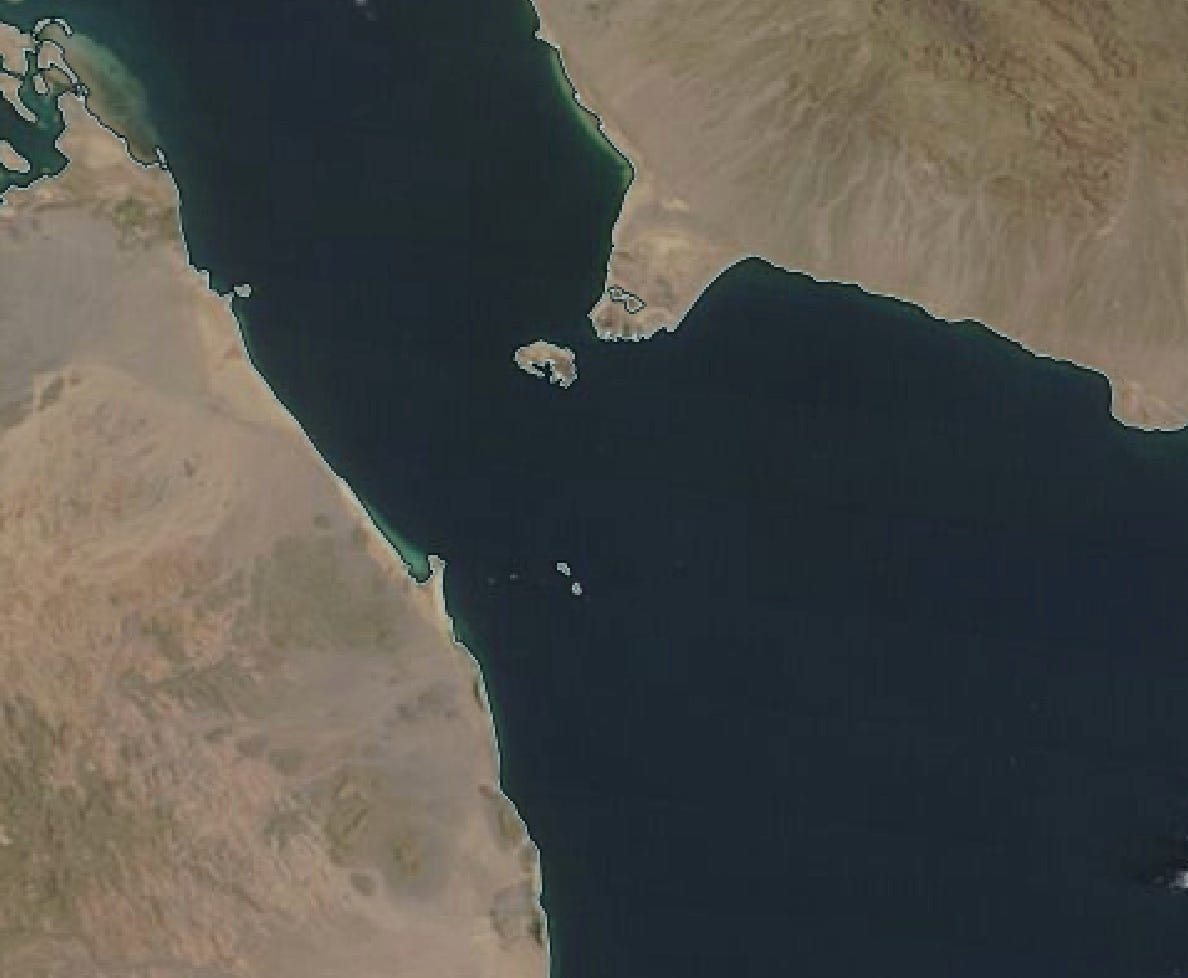
On Thursday the Houthis took Mocha. On Friday they reached Dhubab and landed fighters on Perim, also called Mayyun, after Yemeni government forces withdrew. A local official and an eyewitness told AFP the takeover of the Bab el-Mandeb area was complete.
They have not closed the strait. The deep-water channel used by international shipping runs west of Perim, and Djibouti and Eritrea hold that bank. The Houthis hold ground beside one channel and the approaches to the other. Geography has become fire control.
Traffic moved before any closure. Kpler counted 15 crossings on Friday against 30 the day before, on a pre-crisis reference near 71 a day. Ships running dark are missed, so the counts are provisional and the direction is plain.
The corridor is open. It is not normal.
A week ago I closed a piece on the sanctions campaign by saying the chokepoint would stay roughly where it was. Somewhat choked. That was one chokepoint. There are now two.
What this means for a board, first
Cape routing moves from contingency to working assumption on the Asia to Europe leg. S&P Global puts the detour at 10 to 15 days, which means more bunkers, fewer ships, higher freight and another fortnight of working capital on the water.
Insurance and charterparty language will bind well before physical closure does. A strait that is open on the chart and commercially uninsurable gives a shipper the same outcome, sooner.
The two are correlated. The same network gains from pressure at both, and the Saudi route built to avoid Hormuz terminates on the Red Sea. Any model treating them as independent understates the tail.
The cost compounds.
The call that was declined
Mohammed bin Salman called Donald Trump twice on Thursday, the first as Mocha fell. In the second he asked for American strikes. Trump declined.
Admiral Brad Cooper travelled to Saudi Arabia. Roughly 200 American personnel were already there on non-kinetic support, with intelligence and targeting data flowing and officials saying there are no plans for direct intervention. A senior administration official put the priority as “ensuring freedom of navigation in the Red Sea” while regional partners lead.
That is a policy. It is also a boundary, and Riyadh has asked Washington to cross it.
In July I asked whether a US chokepoint doctrine was emerging. A Hormuz toll announced and withdrawn. Kharg Island publicly weighed. Panama’s concessions reopened through the courts. The instinct each time was to put state power on the leverage point. An ally has now asked for one to be held on its behalf and received targeting data.
The doctrine appears where a chokepoint can be owned, priced or bypassed. It has yet to appear where one must be held for somebody else.
Nobody agrees how open Hormuz is
Trump said on 3 September that Hormuz volumes were back at 18 million barrels a day against 20 million before the war. The trackers disagree with him and with each other. TankerTrackers had crude at 3.8 million over the week to 30 August, while Kpler revised its August estimate up to 8.6 million once dark transits were captured. The Joint Maritime Information Centre logged 59 US-facilitated transits in 48 hours while independent tracking showed single digits. The EIA warns that Hormuz vessel data have been unreliable since February.
A board cannot plan on a figure that two governments and several trackers each define differently. Treat official transit numbers as advocacy, buy the commercial data and plan from the lower end.
The timetable has the same problem. Trump said on Wednesday the war ends immediately after the November midterms. The Wall Street Journal reported that day that Vance, Rubio and other senior advisers have privately warned him it could run past January 2029.
The instrument does not reach the fighter
There is a second reason for the refusal, and it is structural.
Operation Economic Outcast works through sectoral designations, secondary sanctions and restrictions on foreign banks’ access to US correspondent accounts. I spent a long stretch of my career running banks that lived or died on that access, in the Gulf, across Asia and in the United States, and outsiders rarely credit the speed of the reaction. Losing it tells a bank it can no longer settle in the currency its customers invoice in. The response then travels further than the designation itself, because an error can be existential while over-caution costs only a client. That overshoot is the weapon.
It has been aimed well. In August the State Department designated a Hong Kong shipping manager whose tanker had loaded Iranian petroleum six times, and a Turkish trader over roughly a million dollars of petrochemicals. On 10 September Treasury reached commanders of Kata’ib Hizballah and a Lebanese Hizballah network it says moved hundreds of millions for the Revolutionary Guard. Every one of them has a US nexus and something to lose.
The leverage fails here. No action published under the campaign names a Houthi target. Sanctions reach facilitators, smugglers and revenue networks, and none of that moves a fighter off Perim.
Where the reroute runs out
In May this series argued Hormuz was becoming a depreciating asset, because a chokepoint the world learns to avoid loses some of the leverage that made it worth holding. Saudi Arabia proved the logic by pushing crude across the peninsula to Yanbu. The EIA has total oil through Bab el-Mandeb rising from 5.4 million barrels a day in the fourth quarter of 2025 to 8.1 million in the second quarter of 2026, while Hormuz fell from 21.6 million to 4.9 million.
The workaround walked into the next chokepoint. Riyadh’s energy ministry said the seven-million-barrel East-West Pipeline was shut as a precaution after attacks on Thursday morning, and that the drones came from Iraq, without naming who sent them. On Saturday Baghdad confirmed the Iraqi origin and dismissed the commander responsible for Maysan province. Riyadh has held off retaliating at the Iraqi prime minister’s request while reserving its right to act. The attackers remain unidentified.
At the Security Council the Saudi ambassador said the kingdom would take “all measures necessary”. I ran banks in the Gulf long enough to recognise that formulation. The private conversation has already failed.
Past Bab el-Mandeb there is the Cape, the last large reroute available.
The price of a strait that stays open
The Joint War Committee identifies areas of elevated risk and sets no prices. Brokers report additional war risk premiums for a single Hormuz transit of between 3% and 10% of hull value, against 0.15% to 0.25% before the war. At the top of that range a $150 million tanker carries a $15 million bill for one crossing. No government has declared Hormuz closed, and the market has priced much of the outcome anyway.
Brent settled at $104 on Friday, up 9% on the week. Friday’s close is the price. The intraday approach to $110 is the fear.
Japan built its energy system around Hormuz, which carried about 93% of its crude before the war. Singapore’s exposure runs through freight, bunker availability and whatever carriers pass through. Freedom of transit through international straits is settled law. Legal entitlement insures nothing.
American producer prices rose 0.4% in August with energy up 4.2%, headline inflation reached 3.4%, and futures put a quarter-point Federal Reserve increase at about 85%.
A strait nobody has closed is now sitting inside the cost of borrowing for everyone.
Charging for passage may be the objective
Hazem al-Assad of the Houthi politburo said on Friday that navigation through the Red Sea and Bab el-Mandeb was “safe and orderly”. That evening the military spokesman Yahya Saree added the exclusion, saying navigation is safe for every company except Saudi ships, which are already banned. On Saturday the group went further on social media, warning against intervention and threatening full closure.
A position that travels from reassurance to threatened closure inside a day is a lever being tested in public. Reassurance carrying a named exception is the opening of a list.
Iran built this model at the other end. OFAC designated the Persian Gulf Strait Authority on 27 May, then two entities presented as providers of marine insurance and safe passage, warning in August that accepting their services or information demands carries sanctions exposure even where no payment changes hands.
If the architecture appears at Bab el-Mandeb, the sanctions instrument finally has something to grip, and what it grips is the shipowner, the insurer or the bank that participates.
Holding one bank creates threat and pricing power. Uncontested command of the strait is a different thing.
Three questions for the minutes
For traders what share of our inbound and outbound volume, by value, transits Bab el-Mandeb or Hormuz, and whose name sits against that number?
And what does six months of Cape routing cost in freight, bunkers, working capital and inventory, and can we produce the figure inside a fortnight?
Has anyone here accepted insurance, guarantees or passage instructions from an authority claiming to control transit at either strait, whether or not money changed hands?
The guarantee that underwrote both waterways was never written down.
It has hung on a shoogly nail since February. This week Riyadh tested it twice by telephone and got its answer.
A note on the date
I wrote most of this in Hawaii on the 25th anniversary of 11 September, after an afternoon aboard the USS Missouri at Pearl Harbour. She lies a 150m from the USS Arizona. Between those two ships sit the beginning of a world war and its end, a few minutes apart in the same quiet water.
Speaking from that deck in 1945, MacArthur told the world the guns were silent. He addressed the defeated as well as the victors, and hoped for a world built on faith and understanding.
What stays with you at both ships is how ordinary the people were. Sailors asleep below a waterline. Office workers arriving early on a clear Tuesday. Families in Japanese cities who were given no say in any of it.
The order built after 1945 rested on sea lanes that stayed open, and Japan rebuilt on that assumption more completely than anyone.
It is now ironically among the most exposed to its failure. Chokepoints and war risk clauses sit a long way from a surrender deck, and near the start of the same sequence.
The costs, when they arrive, are rarely carried by the people who had the chance to prepare.
Six days before I stood on that Missouri deck, US Central Command announced it had destroyed an Iranian tanker in the Gulf of Oman and disabled two others, and published explicit footage.
80 years on.
The silence has not held.
Ray Ferguson writes the Infinite Horizons Substack on leadership and judgement in a messy world. Signal Stack reads geopolitics, markets and structural change. Tech Stack reads AI, technology and cyber. Each edition is written plainly, for board-level readers, with evidence ahead of opinion and no patience for jargon. Full archive of previous Signal Stacks. Ray is a chairman and international banker with 35 years of leadership across Asia, the Middle East, Europe and the Americas. Former CEO of Standard Chartered Americas, CEO of Standard Chartered Singapore and SEA, UAE and Oman, and Deputy CEO of Bank ABC, Bahrain. Chair of insurer Singapore Life, 36ZERO Marine Group, and ESGpedia, Asia’s leading ESG data and technology company. Views expressed are personal. Singapore citizen, ocean sailor, Criticaleye board mentor, and author of Infinite Horizons: Seasons in The Sun, Life & Leadership Lessons, published by World Scientific and available now. It sets out what that career taught him about judgement, stewardship and endurance, and about the discipline required to sustain a life alongside the work. It takes the form of a memoir at its core. All author proceeds go to the Wheelchair Rugby Association of Singapore.
Join the conversation
Comments and replies take place on Substack, where Ray reads and responds.
1 comments so far.
INFINITE HORIZONS
Get each edition by email
Free. Delivered by Substack. Unsubscribe from any email.
Infinite Horizons is published by World Scientific and available now.
Buy the book

