

the week Beijing takes the wheel
China holds the legal cards, Israel targets marked, and the muddle-through is the base case. Written from Troon, where the Postage Stamp reminds the narrowest target is always the most consequential.
· 7 min read
Infinite Horizons: Signal Stack Series · Ray Ferguson · Troon, Scotland 10 May 2026
The most important development of the past week did not happen in the Strait of Hormuz. It happened in Beijing on 2 May, when China’s Ministry of Commerce issued Announcement No. 21. The operative language uses three unambiguous negatives. Chinese citizens, companies and organisations covered by the order are directed: shall not recognise, shall not enforce, shall not comply with US sanctions targeting Chinese firms buying Iranian oil. That is not a diplomatic protest. It is a legal architecture. Issued as a deliberate prelude to a summit, it tells every company operating in both markets that they now face a binary: comply with Washington or comply with Beijing. The third lane has narrowed sharply. The announcement was Beijing’s welcome mat for Trump’s arrival. The rules of the road are being rewritten, and they are being rewritten in Beijing.
What Xi is actually holding
Independent analysts converge on the same pre-summit read: China feels confident enough to stand up to Trump on sanctions, technology controls, critical minerals, and Iran. Xi has shown little appetite to pressure Tehran, preferring to let the US embroil itself in another Middle East conflict. US officials allege Chinese satellite firms supplied imagery used to target US and allied assets. Beijing has blocked Meta’s $2 billion purchase of AI startup Manus. Rare earths controls remain tight. The blocking statute is deployed. Xi arrives having already moved the board.
The summit will be less a turning point than a diagnostic. Substantively, the outcomes are likely to be modest: symbolic trade gestures, cautious language on technology, ambiguous signalling on Iran.
The US and China are no longer negotiating within a shared global system. They are competing to shape two different systems. The summit is a snapshot of that divergence. Trump told Truth Social: “President Xi will give me a big, fat hug when I get there in a few weeks.” That is a president who needs the optics of the summit more than its substance. Xi knows it. That asymmetry is Beijing’s operating leverage for the next five days.
What Xi cannot fully deliver
China’s position on Iran has three sides. Iran remains linked to the broader Eurasian balancing coalition involving China and Russia. Any Chinese move perceived as facilitating a strategic defeat for Tehran risks weakening that wider coalition. Beijing can ask. It cannot compel. Wang Yi called for a “prompt resumption of shipping traffic through the Strait of Hormuz” in the Araghchi meeting on 6 May, but that point was absent from Iran’s own readout on Telegram.
That gap between what Wang said and what Tehran published is the clearest single expression of China’s limitation. What Xi can credibly offer Trump is the appearance of Chinese pressure on Iran combined with a framework for continued engagement. The face-saving architecture both sides need to leave Beijing without a visible failure. That is what the summit will produce. It will not produce a reopened strait.
The architecture that could actually reopen the strait is now in the public domain. Richard Haass, writing in Home and Away on 5 May, proposed a Strait First approach: a new authority including Iran but not dominated by it, a modest fee structure benefiting littoral countries, and an Indo-Pacific military presence. The direction this series has been pointing toward since A Hormuz Chokepoint Precedent on 11 April.
Israel: targets marked, green light pending
Israel's military posture remains on a war footing. Defence Minister Katz has said publicly that targets are marked and a US green light is the only variable. The Wall St Journal reported today that Israel built a clandestine military outpost in the Iraqi desert with US knowledge before the war started. The more likely read for this week: Washington withholds authorisation through the summit window. Watch whether Katz speaks. Silence means stand-down for Beijing.
The three options, sharpened
Option 1: Double down. Escalate to deescalate. Sustained kinetic campaign, Kharg Island, Naval Special Warfare Development Group securing nuclear material, the strait forced open by removing the physical capacity to close it. This requires Gulf base access that is conditional on consultation, munitions the picture may not support, and a domestic political tolerance for escalation that is declining as the story fades from Western front pages. A sustained Iran campaign while simultaneously fighting a legal war with Beijing over sanctions compliance is a two-front conflict Washington cannot currently win. The conditions for double-down exist. The political will does not.
Option 2: The deal. The deal path has four constraints that have not all appeared together in any single published analysis.
a. Iran’s leadership has every domestic incentive to absorb punishment rather than yield, the war is existential for Tehran, a pump price problem for Washington.
b. The deal path was blocked before by Washington’s own hand: on approximately 17 April all conditions for a ceasefire were in place and the US blockade remained.
c. The Israeli-aligned faction inside the administration has blocked the exit before and travels to Beijing with Trump.
d. Iran does not negotiate under deadline pressure while under threat of bombardment. The deliberate silence on the MOU is not indecision. It is the signal.
One further constraint has not appeared in any published analysis. Iran does not see five GCC states. It sees four pragmatic neighbours and one co-belligerent. Any Hormuz governance architecture that treats the UAE identically to Saudi Arabia, Qatar, Kuwait, and Bahrain will fail at the Iranian end. That differentiation is the unnamed constraint in every proposal currently on the table, including the Haass Strait First framework.
Option 3: Muddle through. The base case. The ceasefire is the fiction both sides are maintaining to preserve the Beijing summit option.
Ceasefire and active combat exist simultaneously. Both are true. The summit produces the language that allows three incompatible positions, US insistence on Hormuz transit, Iranian insistence on sovereignty, and Chinese insistence on buying Iranian oil without US legal consequences, to coexist for another quarter. The muddle-through is not a resolution. It is a structured deferral.
The question is whether the summer buys enough time for one of the other two options to become viable, or whether deferral hardens into permanence.
Five signals this week
Whether Trump arrives with a signed or near-signed MOU from Pakistan. A signed MOU changes the summit from negotiation to ratification. Whether Washington extends secondary sanctions to Chinese state banks. That escalation forecloses the muddle-through. Whether Katz gets his green light before Thursday. Silence means stand-down. Whether Xi names Hormuz specifically in his closing statement. Vague freedom-of-navigation language confirms the face-saving outcome. Specific operational language on timing or mechanism means Beijing has moved. Whether China deploys naval escorts for Chinese-flagged tankers attempting Hormuz transit. That tests the Caine doctrine established in Any Vessel directly. A US decision to board a Chinese vessel forces Washington to choose between backing down or a maritime confrontation with Beijing in the strait. One new signal added this morning. Witkoff and Rubio met Qatari Prime Minister Sheikh Mohammed bin Abdulrahman Al-Thani on Saturday for an hour of talks on supporting the Pakistani mediation efforts. The Qatar channel is now confirmed active alongside Pakistan. Two mediation tracks running simultaneously into the same summit week is either coordination or competition. Worth watching which.
The Singapore read
Singapore sits inside every legal and financial flow this week is testing. Chinese companies caught between Announcement No. 21 and US sanctions are making compliance decisions that run through Singapore-domiciled entities, Singapore banks, and Singapore-regulated insurance markets. PM Wong planted the marker at Cebu on Thursday: “Allowing any party to weaponise and restrict transit through an international waterway like the Strait of Hormuz could set a dangerous precedent that threatens sea lanes closer to home.”
He is right. There is a non-obvious alignment worth naming. China’s Announcement No. 21 asserts that international commercial relationships cannot be unilaterally governed by US domestic law. Singapore’s UNCLOS position asserts that international transit passage cannot be unilaterally restricted by any state. Both defend the primacy of international rules over unilateral national power. Beijing and Singapore are not natural allies on Hormuz.
China’s petroyuan interest and Singapore’s freedom of navigation interest are structurally different. But this week they are making parallel legal arguments from different frameworks, and Washington is the party both arguments are directed at.
That convergence is the architecture of the post-summit alignment Singapore should be quietly building. Singapore’s answer: remain useful to both, price everything fully, refuse to be made use of. It has never been harder to execute. In The Two-Week Window, published 2 May, I set a 65/35 toward kinetic resumption. The muddle-through probability has risen as the main call as the summit approaches. The grand bargain has not. The game’s a bogey on comprehensive settlement this week. What Beijing produces on Friday is the shape of the next quarter.
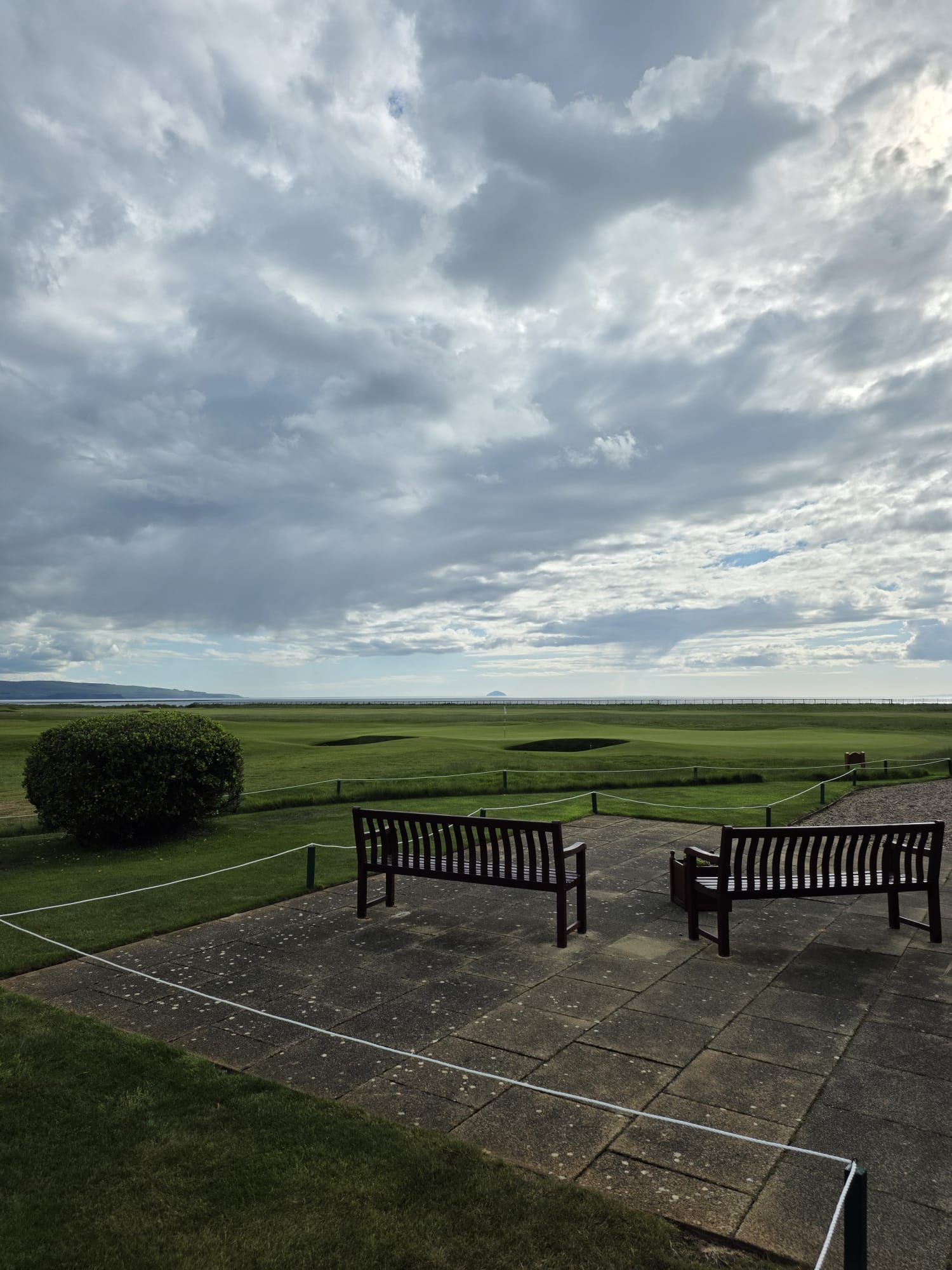
Written this Sunday from Troon, home of The Open Championship this July, where the 8th hole, the Postage Stamp, the smallest green in major championship golf, ringed by bunkers, sits as a reminder that the narrowest target is always the most consequential. The Strait of Hormuz is two miles wide. The Postage Stamp is smaller still. The signal returns to physical shortly after that.
Ray Ferguson writes the Infinite Horizons Substack. Signal Stack covers geopolitics and markets. Tech Stack covers AI and technology. Ray is a chairman and international banker with 35 years of leadership across Asia, the Middle East, Europe and the Americas. Former CEO of Standard Chartered Americas, CEO of Standard Chartered Singapore and SEA, UAE and Oman, and Deputy CEO of Bank ABC, Bahrain. Chair of insurer Singapore Life and 36ZERO Marine Group. Singapore citizen, ocean sailor, board mentor, and author of the memoir Infinite Horizons: Seasons in the Sun: A Memoir of Leadership and Life.
If this was useful, share it with someone who needs to read it.
Join the conversation
Comments and replies take place on Substack, where Ray reads and responds.
INFINITE HORIZONS
Get each edition by email
Free. Delivered by Substack. Unsubscribe from any email.
Infinite Horizons is published by World Scientific and available now.
Buy the book

