

Beijing summit week. Trump arrives weaker than he intended.
Iran has hijacked the agenda. The intelligence undercuts the public narrative. Singapore offers Iran the Malacca model. Here is the consolidated read.
· 5 min read
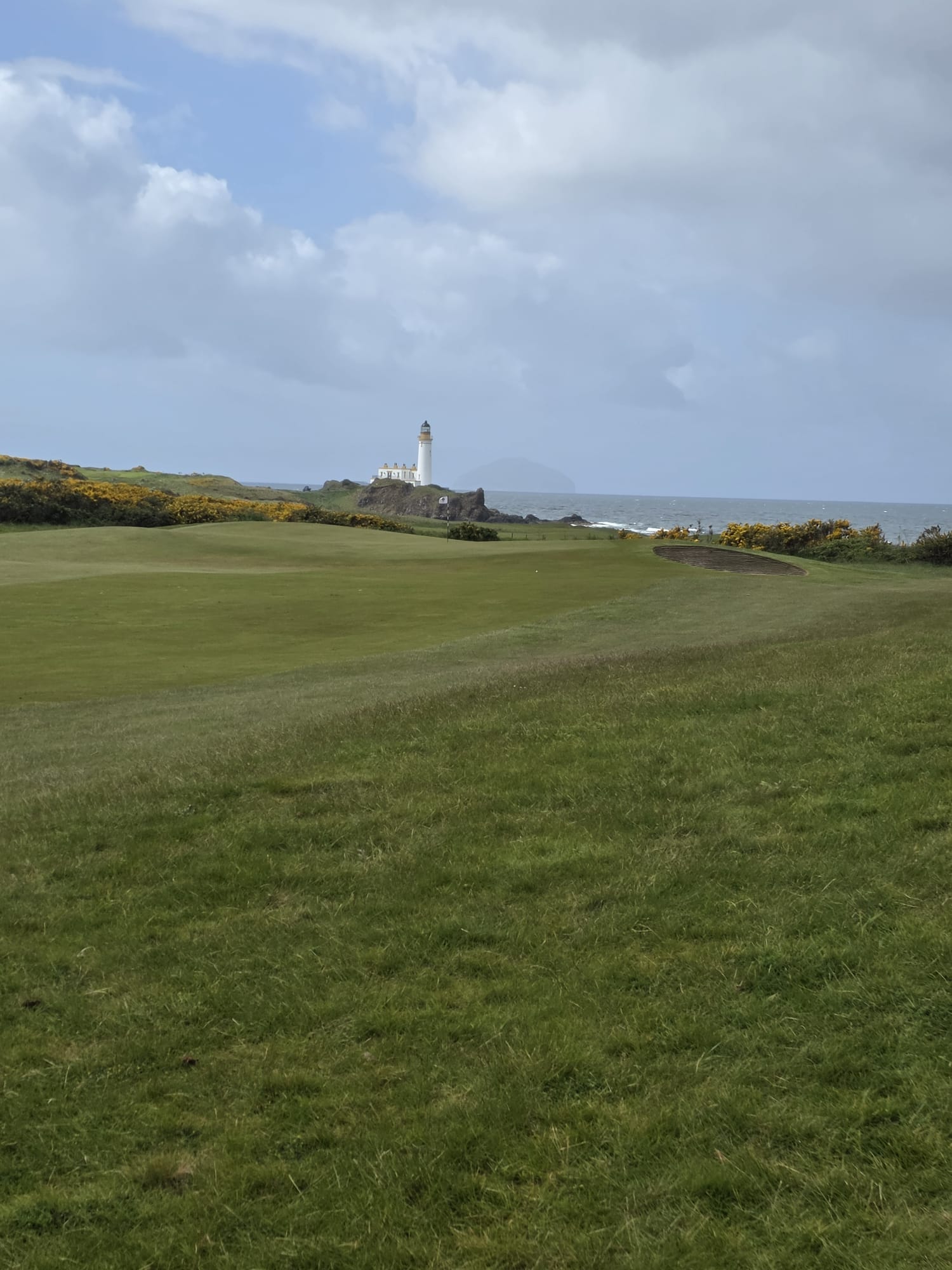
Infinite Horizons: Signal Stack Series · Ray Ferguson · Trump Turnberry, Scotland 13 May 2026
Trump arrives in Beijing Thursday. He arrives weaker than he intended. A former senior US official told CNN: "These are not the strategic conditions you would want to have going into a major power summit." Beijing prepared for a trade summit. Iran has hijacked the agenda. The kinetic signals are sharpening. Trump called the ceasefire "massive life support" and Iran's response "a piece of garbage." CNN sources say Trump aides are seriously considering combat resumption. An Ohio-class submarine moved into Gibraltar. Treasury sanctioned 12 companies facilitating Iran-China oil. Bessent meets Vice Premier He Lifeng in Seoul today.
The intelligence picture cuts against the public narrative. The New York Times reported Tuesday that classified US assessments show Iran has regained access to 30 of 33 missile sites along the Strait of Hormuz and retains 70 per cent of its prewar stockpile. Trump called the report “virtual treason.” The gap between his public claims and his own classified intelligence is what Beijing will be pricing. Araghchi arrives in Delhi Thursday and Friday for the BRICS Foreign Ministers meeting alongside his Saudi and Egyptian counterparts. Iran is running parallel diplomacy. Tehran is not waiting. It is preempting. This is the week Beijing takes the wheel. Here is the call.
What Xi is actually holding
CFR’s pre-summit assessment: each day the strait remains closed, China’s long-term position grows stronger. China’s electrostate, its booming exports of batteries, solar, and grid infrastructure, benefits from every day the Hormuz shock drives importers toward electricity alternatives. Xi arrives knowing the structural gains are banked. Iran has displaced trade, rare earths, and supply chains as the dominant agenda item. Chatham House: Beijing’s restraint should not be mistaken for unreliability. Beijing is patient. Patience is the leverage. Beijing can ask Tehran to move. It cannot compel. Wang Yi called for prompt reopening at the Araghchi meeting. Iran’s Telegram readout omitted that point. The operational limit of Chinese leverage stated in two documents side by side.
Singapore takes a public position
Singapore’s Foreign Minister Vivian Balakrishnan held a phone call with Iranian Foreign Minister Araghchi this week. He reasserted Singapore’s UNCLOS position, pressing for full reopening of the Strait. He raised Iran’s NPT obligations. I spotted Vivian’s readout on his Facebook page on 12 May. The next day in Jakarta with Indonesia’s Sugiono, Balakrishnan invited Araghchi to see how Indonesia, Malaysia, and Singapore keep the Strait of Malacca open. Singapore is offering Iran the Malacca model as the alternative to the Hormuz toll architecture. The timing matters. The call landed the week Trump arrives in Beijing. Singapore made its position visible to Tehran at the moment Xi is making his. The operational layer sits beneath it. MAS carries compliance exposure across Chinese institutions caught between Announcement No. 21 and US secondary sanctions. Singapore-flagged tonnage transits the Strait. Singapore-domiciled war risk insurers price Hormuz at multiples of pre-war levels. The operational stakes are why Singapore needs the architecture to hold.
The deal path has hardened
None of the constraints I named in Signal Stack: the week Beijing takes the wheel has resolved. They have hardened. Iran has every incentive to absorb punishment rather than yield. The war is existential for Tehran. It is a pump price problem for Washington. The Israeli-aligned faction that blocked the April ceasefire is boarding the plane with Trump on Thursday. The silence on the MOU was the signal. “Life support” is the counter-signal. Iran’s deputy speaker of parliament said this week: “The Strait of Hormuz is our nuclear weapon.” The doctrine has shifted. The Strait is treated as deterrent infrastructure on par with the nuclear file. That is the constraint Beijing inherits. Former Qatari PM Sheikh Hamad bin Jassim told Al Jazeera the Strait crisis is “the most dangerous outcome” of the war and called for a Gulf NATO. The Gulf is reorganising while Trump and Xi posture.
The grievance Xi carries into the room
The JV Innovation, a Marshall Islands-flagged tanker with Chinese owner and crew, was attacked off the UAE’s Al Jeer port on 4 May. China’s Foreign Ministry confirmed the strike. A source told Caixin this was the first Chinese oil tanker targeted and it was “psychologically hard to accept.” Not a legal threshold. A psychological one. Xi arrives as a party whose vessels have been struck. That is not a negotiating position. That is a grievance. It gives Xi the standing to tell Tehran the closure must end.
The call for the week
Three outcomes remain in play. The double-down requires Gulf base access that is conditional, munitions whose adequacy is questioned, and a domestic tolerance for escalation that is declining. But Trump aides are talking. The Ohio-class is in Gibraltar. 30 of 33 Iranian missile sites along Hormuz are operational. The tail is heavier than at any point in this series. The deal requires Iran to move on nuclear sequencing and the US to lift its blockade simultaneously. The gap between “life support” and a signed MOU in 72 hours is wide. The muddle-through is the likely outcome. Face-saving language. Neither the MOU closes nor the kinetic option executes. The strait stays at 5 per cent of pre-war capacity. The outcome both principals can survive politically through Friday. One reminder amid the bluster. The Strait is still closed. Global trade is suffering like a cancer. Trump told CBS News he wants to suspend the federal gas tax, costing half a billion dollars a week. Gas prices up 50 per cent since 28 February. Spirit Airlines has shut down. The rhetoric is the symptom. The closed strait is the disease. In The Two-Week Window I set 65/35 toward kinetic resumption. The game’s a bogey on a comprehensive settlement.
Five signals to watch
Whether Trump arrives with a signed MOU from Pakistan. That changes the summit from negotiation to ratification. Whether Bessent-He Lifeng in Seoul produces de-escalation or hardens the architecture. Whether Katz speaks this week. Silence means stand-down. Whether Xi names Hormuz specifically Friday. Vague language confirms face-saving. Specific operational language means Beijing has moved. Whether China references the JV Innovation strike again. Silence preserves the summit. Public reference repositions Xi from broker to grievance-holder. Written from Trump Turnberry on the Ayrshire coast. Trump has rejuvenated this estate since I was last here eighteen years back. The commercial Trump has done good work. This week the world finds out which Trump is in the summit room.
Ray Ferguson writes the Infinite Horizons Substack. Signal Stack covers geopolitics and markets. Tech Stack covers AI and technology. Full archive of past pieces. Ray is a chairman and international banker with 35 years of leadership across Asia, the Middle East, Europe and the Americas. Former CEO of Standard Chartered Americas, CEO of Standard Chartered Singapore and SEA, UAE and Oman, and Deputy CEO of Bank ABC, Bahrain. Chair of insurer Singapore Life and 36ZERO Marine Group. Singapore citizen, ocean sailor, board mentor, and author of the memoir Infinite Horizons: Seasons in the Sun: A Memoir of Leadership and Life.
If this was useful, share it with someone who needs to read it.
Join the conversation
Comments and replies take place on Substack, where Ray reads and responds.
INFINITE HORIZONS
Get each edition by email
Free. Delivered by Substack. Unsubscribe from any email.
Infinite Horizons is published by World Scientific and available now.
Buy the book

