

The $10 Billion Quiet: How the UAE Bought Its Way Out of Iran’s War
Bahrain, Kuwait and Jordan took Iranian fire this week. The UAE took none. Reuters found the $10 billion. Abu Dhabi denies it. The missile pattern says otherwise.
· 6 min read
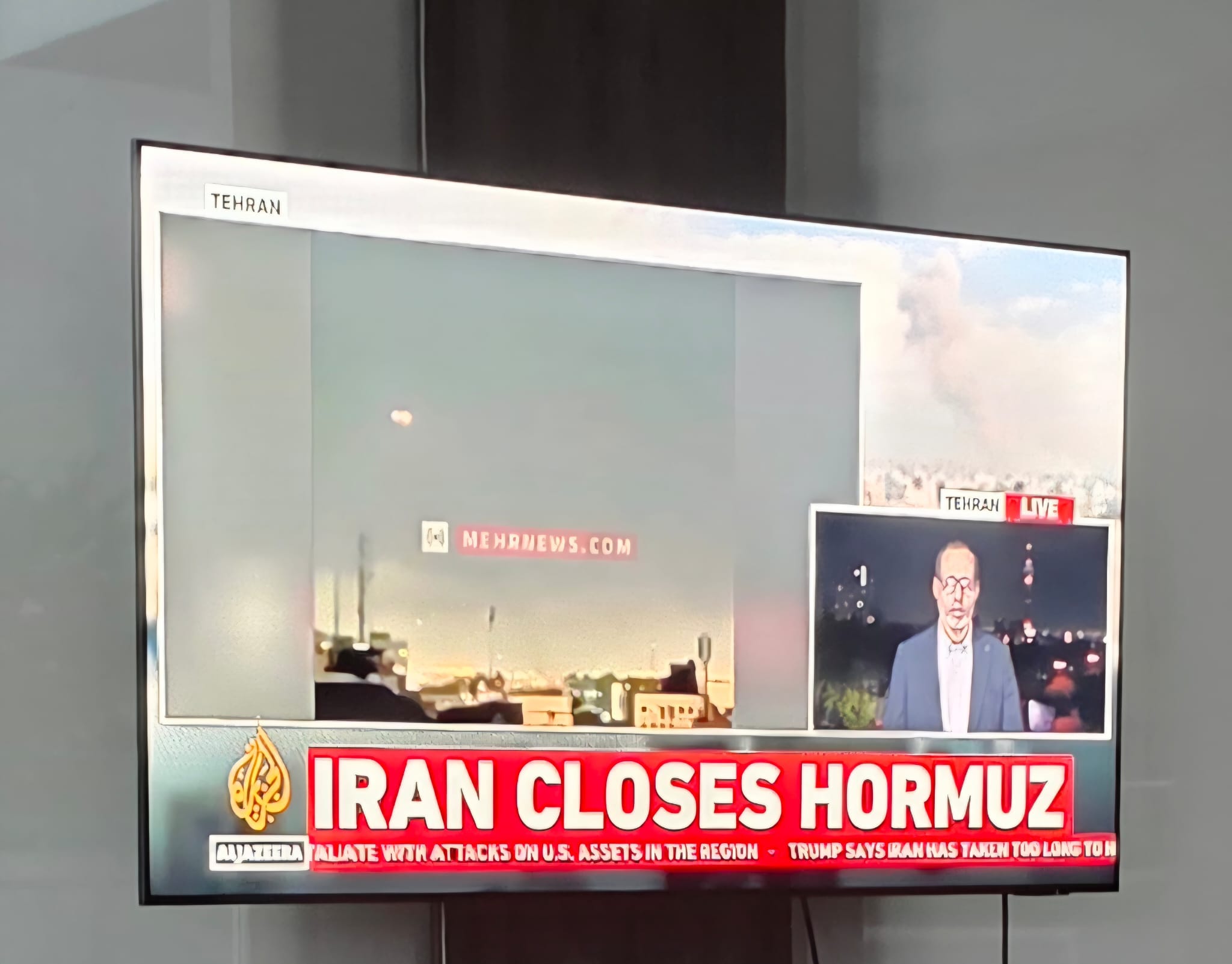
This week Bahrain hit, Jordan hit, Kuwait engaged. The UAE quiet?
Infinite Horizons · Signal Stack · Ray Ferguson · Singapore · Saturday 13 June 2026
Watch what was hit this week, and what was not. Iranian drones reached the US Fifth Fleet headquarters in Manama. Missiles reached Muwaffaq Salti air base in Jordan. Kuwait’s air defences engaged seven inbound ballistic missiles. An eleven-year-old girl in Bahrain was injured by falling interceptor debris. The UAE, which absorbed more Iranian ordnance than any Gulf state, and on some counts more than Israel, in the February-April phase, took nothing. Its last direct hit was Fujairah port on 4 May.
On Friday, Reuters reported, and Al Jazeera carried, what would explain the quiet. Abu Dhabi has agreed to release $10 billion to Tehran, possibly $20 billion, with more than $3 billion already delivered. The funds are frozen Iranian assets, unlocked after IRGC officials stayed at the guesthouse of Sheikh Tahnoun bin Zayed, the UAE national security adviser, and a return delegation went to Tehran to settle mechanics. A source told Reuters the release was directly linked to safe passage through the Strait of Hormuz.
The UAE foreign ministry issued a categorical denial within hours: no frozen Iranian assets released, transferred, or moved through the UAE. Abu Dhabi denies. The missile pattern says otherwise. Five weeks of UAE quiet while every other US-hosting Gulf state takes fire is corroboration no press statement erases.
Protection is now purchasable
The structural insight is bigger than one transfer. For eighty years, Gulf security ran on one model: American protection in exchange for alignment. That model produced the basing architecture, the dollar oil trade, and the assumption that an attack on Abu Dhabi triggers Washington. This war repriced all of it. Bahrain hosts the Fifth Fleet and has absorbed over 100 days of intermittent fire. Hosting America now attracts fire. Paying Tehran deflects it.
Abu Dhabi has read the change fastest. It exited OPEC in April, the institutional break “Rebuilding the Room” traced at the time, and the Tehran channel is the same instinct applied to security. It signed twenty-four agreements with Beijing the same month. It has now built a bilateral financial channel to Tehran that operates regardless of what Washington signs this weekend. The UAE has moved past hedging into a complete parallel security policy, paid in Iran’s own frozen money, structured so Washington can deny that sanctions were lifted. Vice President Vance supplied the formula: benefits flow to Tehran if it meets obligations. The obligation, on the evidence of this week, is not shooting at the people who pay.
Before judging Abu Dhabi harshly, judge it in context. The UAE runs the region’s most open economy: nearly ninety per cent of its residents are foreign, and the model rests on the confidence of people and capital that can leave on the next flight. It took the war’s heaviest damage and has no recovery path that does not start with stability. Someone in the Gulf had to price peace first. It was always going to be the state with the most to lose from its absence.
Every capital dependent on Gulf energy will study this precedent. Deterrence has a price list now. The question each government must answer is what it buys, from whom, and what happens to states that cannot afford the premium.
The deal signs. The architecture does not change.
The Islamabad Memorandum, as Foreign Minister Araghchi now calls it, was confirmed as agreed text by Pakistan’s Prime Minister Shehbaz Sharif on Friday. The signing is expected in Geneva, likely Sunday, timed against the G7 at Evian. Vice President Vance signs for Washington, opposite Parliament Speaker Qalibaf for Tehran. Vance, the same day Sharif declared the text final, called it still TBD. The deal that ends America’s war is branded for the city that brokered it and signed by the deputy of the president who fought it. Pakistan convenes, backed by its September 2025 mutual defence treaty with Riyadh. The UAE finances. China anchors the demand floor for Iranian crude. The US signs.
Trump’s own week told the deeper story. He threatened to seize Kharg Island and run Iran’s oil “much like Venezuela” in the morning, and cancelled the strikes by the afternoon. The line that will last came on Fox News: “My preference has always been to take Kharg Island. But I don’t know that America has the stomach.” The Pentagon’s arithmetic explains the admission. CSIS estimates the US has expended more than half its prewar inventory across several key interceptor categories. THAAD has fired over 150 interceptors with no new deliveries since August 2023, and the Pentagon projects no full replacement until 2029. Iran’s missile inventory is equally finite. Both sides have hit the munitions ceiling, and the recapitalisation race, not the diplomacy, is what buys this deal its first year.
Israel is the absence in the room. Netanyahu signs under personal pressure, his coalition needs the war, his trial continues, and the deal text reportedly requires US consultation on every strike against Hezbollah. Iran commits on paper to stop arming a militia it considers essential deterrence. The Lebanon contradiction is written into the framework. On Netanyahu’s record through this war, partial compliance and eventual re-escalation is the base case, with a meaningful chance of a full break inside three months.
The sword stays hung
The strait reopens under the deal. Iran’s capacity to close it again stays. The Persian Gulf Strait Authority keeps its registry, its clearance system, and its fee schedule, rebranded from tolls to navigation services. The Iran-Oman protocol asserting joint governance of the waterway stays drafted. The mines come out within thirty days; the ability to relay them is untouched.
This is the permanent change to price in. Hormuz now carries a standing threat architecture that survives the ceasefire, the precedent “A Hormuz Chokepoint Precedent?” named in April now formalised. The war-risk premium, the insurance repricing, the rerouting economics and the energy diversification programmes across Asia do not unwind. They compound. Helium remains the sharpest case: roughly a third of global supply runs through Ras Laffan, offline since the March force majeure, with QatarEnergy guiding multi-year restoration for the damaged trains. South Korea sources around two-thirds of its helium from Qatar, and the fabs in Hwaseong and Hsinchu price that dependency daily.
A reader in any trade-dependent capital should retain three things from this week. Security in the Gulf has become transactional, and the transaction works. The power that convenes the region’s peace is no longer the power that patrols its waters. And the chokepoint that carries two-thirds of Asia’s crude will operate indefinitely under the sword of a state that has now demonstrated, twice, that closing it is survivable.
Asia is already acting on all three. South Korea has cut Middle Eastern crude from 69 per cent of imports a year ago to 48 per cent this quarter, with US barrels alone now at 25 per cent and African supply nearly quadrupled; HD Korea Shipbuilding alone has booked sixteen LNG carriers this year, more than double its 2025 total, because the Middle East short-haul has been replaced by Atlantic long-haul and the steel is being cut now for routes that did not exist in February. India is buying Iranian crude for the first time since 2019, sourcing from more than forty countries, and this week summoned the senior US diplomat in New Delhi after the Settebello strike left one Indian seafarer dead and two missing. Buying from Tehran while protesting to Washington is the pivot compressed into a single country. Every substitution that beds in becomes the new baseline, and the replacement infrastructure does not get unbuilt when the strait reopens. The Gulf’s customers are leaving a relationship the Gulf assumed was permanent, and they are leaving in the orderly, undramatic way that never reverses.
The deal signs this weekend or on Monday. The Gulf it leaves behind will never be the same, because Asia has stopped planning around the Gulf it used to be. Read the new map now.
Ray Ferguson writes the Infinite Horizons Substack. Signal Stack covers geopolitics and markets. Tech Stack covers AI and technology. Full archive of previous Signal Stacks. Ray is a chairman and international banker with 35 years of leadership across Asia, the Middle East, Europe and the Americas. Former CEO of Standard Chartered Americas, CEO of Standard Chartered Singapore and SEA, UAE and Oman, and Deputy CEO of Bank ABC, Bahrain. Chair of insurer Singapore Life, 36ZERO Marine Group, and ESGpedia, Asia’s leading ESG data and technology company. Singapore citizen, ocean sailor, board mentor, and author of the memoir Infinite Horizons: Seasons in the Sun: A Memoir of Leadership and Life.
If this was useful, share it with someone who would benefit.
Join the conversation
Comments and replies take place on Substack, where Ray reads and responds.
INFINITE HORIZONS
Get each edition by email
Free. Delivered by Substack. Unsubscribe from any email.
Infinite Horizons is published by World Scientific and available now.
Buy the book

