The Dust and the Toll: Two Tests for a Signature
The deal is reached, the signing set for Friday. Two tests decide whether it holds. Does the uranium leave Iran. Does the strait reopen free or priced.
· 7 min read · 1 comments
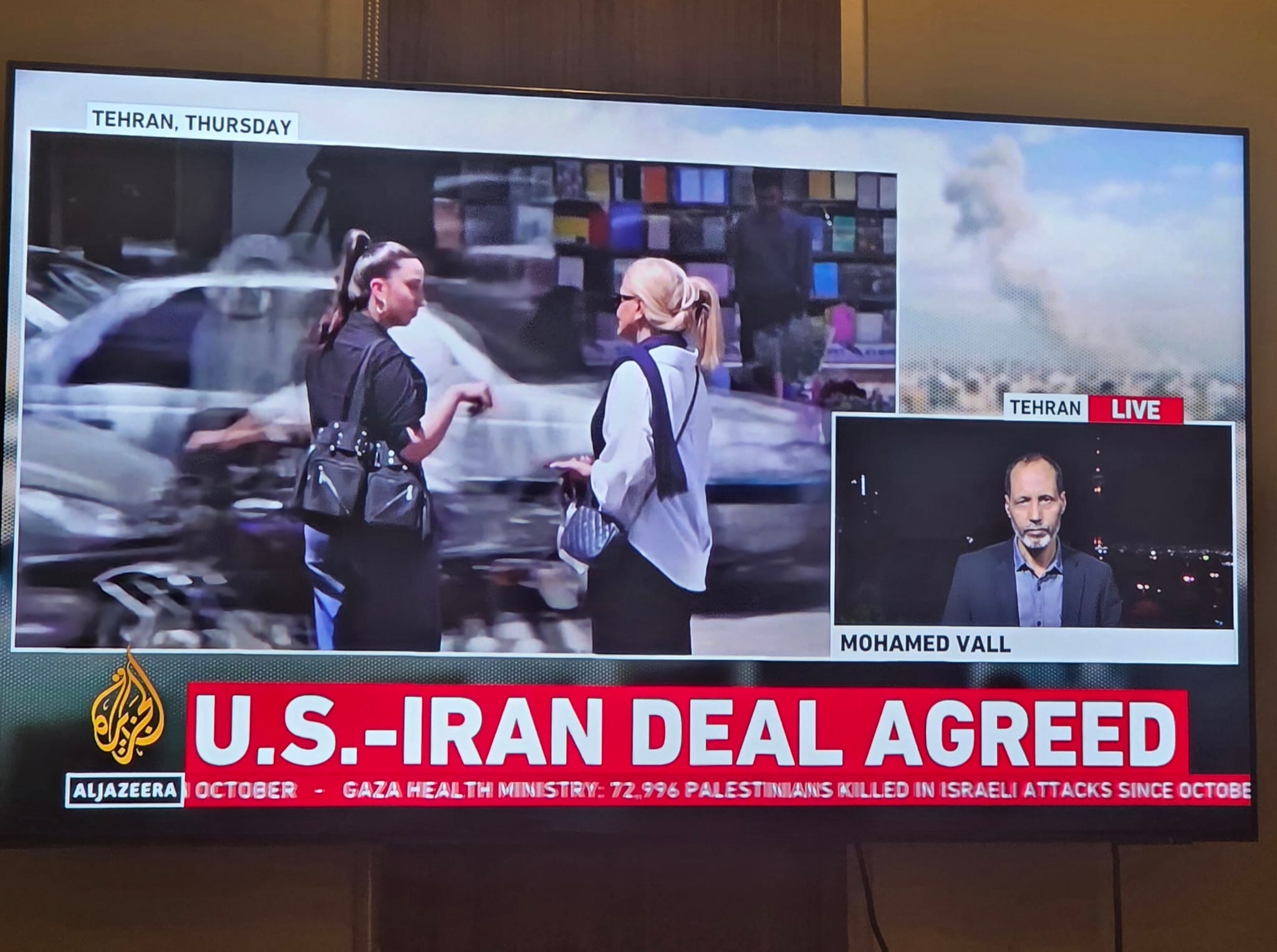
Singapore. The same screen, ten weeks on. Closed, then agreed.
Infinite Horizons · Signal Stack · Ray Ferguson · Singapore · 15 June 2026
The deal is reached. Pakistan’s Shehbaz Sharif announced on Sunday that the United States and Iran have agreed peace terms, with both sides declaring the immediate and permanent termination of military operations on all fronts, including Lebanon.
Trump posted within hours: “The Deal with the Islamic Republic of Iran is now complete. I hereby fully authorize the toll free opening of the Strait of Hormuz, and the immediate removal of the United States Naval blockade. Ships of the World, start your engines. Let the oil flow.”
The signature is deferred. Each side signs electronically, with a ceremony set for Friday 19 June in Switzerland. The fourteen-point text runs in two stages. Stage one reopens Hormuz with no tolls, clears the mines, lifts the blockade, releases $25 billion of Iran’s frozen assets, waives oil sanctions, and ends the war on all fronts including Lebanon. Stage two, a sixty-day window, takes the nuclear file and the stockpile. The war that opened on 28 February with the strike that killed Ali Khamenei now has a peace deal, carried for Iran by the son of the man that strike killed, Supreme Leader Mojtaba Khamenei.
No one has the text. What is public is briefing and signalling: US officials on background, Araghchi on Iranian state media, Trump on Truth Social, leaks to Reuters and Axios. The fourteen points below are the reported shape of a document still unsigned, and Friday could contradict any of them. The announcement and the signature sit five days apart, The gap is the point. Everything hard is pushed into stage two. Four months have produced a ceasefire, an extension, a memorandum and a Beijing framework, and only the 8 April two-week ceasefire was ever put in force, the one Trump later called “on life support.” This is the latest iteration. What it is worth comes down to two distinct tests.
Hold the victory laps lightly. Trump calls the deal complete and the strait his to open, and the announcement will be read in Washington as a win. The longer view is more sobering. This war has scrambled the international landscape in ways no signature reverses: a Supreme Leader killed and succeeded, the Gulf security order repriced, the petrodollar tested, the chokepoint precedent set, the customer base moving. A ceasefire reached on paper is the end of the beginning. The end itself is further off, and who actually gained will read clearer over the next year than it does in this weekend’s banners. The two tests are where that reading starts.
The first test is the dust
Does the enriched uranium leave Iran. Trump’s “nuclear dust” post said the US would enter Iran and remove it physically. The deal does the opposite, deferring the nuclear file to stage two, with Iran’s public position so far to dilute the roughly 440-kilogram stockpile inside the country and hold it there. Watch for an IAEA or US team being given access to the stockpile in the sixty-day window. If that happens, the deal has a clearer claim to substance. If the material stays under Iranian control while the strait reopens, the peace bought a ceasefire and left the casus belli in place. On the evidence publicly available today, the dust does not yet appear to be on its way out.
The second test is the toll
Does the strait reopen free, or priced. The mid-May Beijing framework, which Signal Stack named “Cold peace at Beijing”, set no tolls as its sharpest principle. That was the standard a month ago.
The two sides describe the same waterway in flatly contradictory terms. Trump posts “toll free opening.” Tehran says otherwise. Araghchi stated that “services in the Strait of Hormuz will no longer be free,” that the strait “is shared between Iran and Oman,” and that its future “will not be like the past.” Taken at face value, both cannot hold. A no-tolls headline with a sovereignty-and-service-fee regime underneath is one plausible way a charge returns wearing a compliance label. Qalibaf was blunter: “We speak other languages far more fluently. Break your commitments, and we’ll switch to what we speak best.” Watch the first fee schedule. If vessels transit free, Trump’s claim held. If they pay, Iran turned a wartime closure into a permanent revenue line, and the precedent travels to every chokepoint a littoral state can hold. On the evidence today, Tehran’s signalling points to a toll or service charge of some kind staying.
The five days to Friday
The gap to signing is where this can come apart, and Israel is the lever. The friction is public now. Trump told Axios this weekend that Netanyahu had “no judgment,” fuming that an Israeli strike on Beirut had nearly killed the deal and “delayed the signing by a few hours.” It was the sharpest US rebuke of an Israeli prime minister in memory, set against a run of moves Israel reads as cutting against it: the halt to the war, the end of strikes on the Houthis, the lifting of Syria sanctions. His own benches called it ceding sovereignty to Washington.
Netanyahu answered from Jerusalem with conditions the memorandum does not meet: all enriched material out, enrichment dismantled, the ballistic file resolved, real inspections. The deal defers every one to stage two. His office called the agreement mere “entry into negotiations.” He faces an election this year, and playing the thrawn holdout who refused a weak deal serves him better than co-signing one that leaves the uranium in Tehran. Iran wrote itself the same exit: Araghchi said that if the memorandum’s terms go unmet, nothing gets signed. Both kept a door open. The structural read is that Israel appears to emerge from this war weaker than the campaign promised, and a leader who must deny that has five days and a sixty-day window in which he can still try to reopen the fight. Partial compliance now, with a real risk of re-escalation later. The risk to the signature runs through Jerusalem.
The reopening is real, and the relief is partial. Brent has given back most of its war premium, from spikes above $114 in March into the high eighties, even as baseline forecasts still cluster near $100 to $105 through the summer. Refined products lagged harder, with Asian jet fuel cracks into the $50s this spring and European diesel at levels traders called “2022-style.” Lifting the blockade is the easy part. Normalising insurance, crewing and routing takes weeks behind it.
The base it writes from
So mark the day. The workarounds held, and that is the trap. The closure pulled fifteen million barrels a day off the market, absorbed by draining reserves. The IEA pledged 400 million barrels in March, its largest co-ordinated release ever, and the US strategic reserve sits at its lowest since the 1980s. Bank models show those emergency flows stepping down sharply over the next two months, just as holiday demand rises and US exports weaken. On those assumptions, the peace, if it holds, likely arrives with the cushion nearly spent. The risk was real. The workaround masked it. The fading crude premium does not unwind that read.
The Gulf is changed for good. The UAE apparently bought its own peace through a bilateral channel, Saudi shut its largest refinery to drone fire, and Pakistan brokered the deal Washington once would have dictated. The customer base that left is unlikely to return on a signature alone. The Asia pivot that “The $10 Billion Quiet” mapped is the durable part: Korea’s crude shift from 69 per cent Middle Eastern to 48 in a year, HD Korea Shipbuilding’s sixteen LNG carriers for Atlantic routes, India’s first Iranian barrels since 2019. The resilience plan endures because the month just lived through has reinforced that it has to.
The muddle did not end on Sunday. It acquired an announcement and a signing date. Watch the dust and watch the toll, over the days to Friday and the sixty after. On the evidence so far, the deal reopens the strait and leaves the sword poised above it. The next iteration writes from an agreed base.
Ray Ferguson writes the Infinite Horizons Substack. Signal Stack covers geopolitics and markets. Tech Stack covers AI and technology. Full archive of previous Signal Stacks. Ray is a chairman and international banker with 35 years of leadership across Asia, the Middle East, Europe and the Americas. Former CEO of Standard Chartered Americas, CEO of Standard Chartered Singapore and SEA, UAE and Oman, and Deputy CEO of Bank ABC, Bahrain. Chair of insurer Singapore Life, 36ZERO Marine Group, and ESGpedia, Asia’s leading ESG data and technology company. Singapore citizen, ocean sailor, board mentor, and author of the memoir Infinite Horizons: Seasons in the Sun: A Memoir of Leadership and Life.
If this was useful, share it with someone who would benefit.
Join the conversation
Comments and replies take place on Substack, where Ray reads and responds.
1 comments so far.
INFINITE HORIZONS
Get each edition by email
Free. Delivered by Substack. Unsubscribe from any email.
Infinite Horizons is published by World Scientific and available now.
Buy the book