Iran on the Back Burner: Strike Window Reopens After APEC
Washington’s attention has moved to Ukraine and to Nvidia and chips. A carrier group, a Qatari deadline and the end of APEC now land in the same week.
· 7 min read · 1 comments
A note to regular readers. This edition is a few days late, and I apologise. Last week brought the midterms and a lot of noise on several fronts, which I work through below. I waited for clarity, and we now have enough to say where things are heading.
The window closed quietly
Central Command had drawn up plans to strike as early as the day after the vote, The New York Times reported. The rungs that matter most stayed dark: no new US airspace prohibition, no ordered departure from Tel Aviv or Baghdad.
On 1 November, in Iran Strike Window, I called it 50/50 and set Friday 6 November as my deadline. None of the three signals that would have moved me appeared. I said I would move to TACO, the market’s shorthand for “Trump Always Chickens Out”, and say so here. I have.
On Monday Trump said it himself. After meeting Qatar’s prime minister he called the war “militarily effectively over” and new strikes “quite unlikely”, because Gulf allies “would prefer the status quo”, Arab News reported. Rubio said the talks had made no progress. No campaign, no deal. That is drift.
Tehran ran its plan
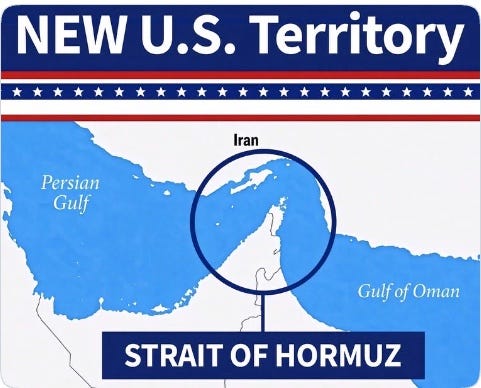
Absorb the strikes. Keep Hormuz partly shut. Let the price land at American pumps before Americans vote.
It worked. Petrol hit $4.15 a gallon on polling day, the highest of any US election. CBS exit polls put Trump’s approval at 38%, and Democrats took both chambers. In the five clocks piece I traced Gulf shocks through freight, crude, fertiliser, sulphur and helium, each on its own clock. This one ran faster than any of them: the weekly fill-up.
Three pressures, one exception
The first is domestic. On Tuesday the House sent articles of impeachment against Hegseth, the cabinet’s leading voice for resuming strikes, to committee by 211 votes to 204, NPR reported. The outgoing Republican majority saved its war secretary by seven votes. A party that has just lost both chambers will not reopen a war the voters punished.
The second is the Gulf. Qatar is carrying the talks, and Iraq’s prime minister flew secretly to Tehran last week at Trump’s request, The National reported. Debris from a Houthi missile damaged an Aramco building in Riyadh on Sunday, CNN reported, and Saudi state media reported an attack on the East-West pipeline the next day. Gulf capitals want the status quo.
The exception is Israel. Netanyahu is now a caretaker, after President Herzog asked Gadi Eisenkot to form the next government, and he is pressing for a new offensive. Sources told Yedioth Ahronoth that his weekend call with Trump was “a shouting match from hell”. Netanyahu’s office called the report fake news. Israel’s army chief, Eyal Zamir, has again warned against the action Netanyahu wants, Channel 12 reported. A caretaker can still order a strike with cabinet approval, which makes Jerusalem the likeliest spark.
Hormuz is a wasting asset
Some American commentary this week claims the world has lost a fifth of its oil, that Gulf fields could restart at only half capacity, and that reserves are spent. The data tell a serious story, and a less apocalyptic one.
In the week to 8 November crude flows through the strait averaged 7.8 million barrels a day, about 46% of the pre-war 17.1 million, on Kpler data reported by The National.
The capacity claim does not survive Aramco’s own figures. Its chief executive, Amin Nasser, said last month that Saudi Arabia could make its full 12 million barrels a day available within days. Less than 10% of the world’s oil stocks are practically available, Nasser says, and rebuilding them could take up to two years.
UKMTO logged 11 attacks on shipping in the week to 4 November, three of them sinkings. On Sunday the IRGC claimed three tankers ablaze. UKMTO confirmed one tanker fire, off Khasab in Oman.
The biggest loser is Iran. Its crude loadings fell to about 210,000 barrels a day in August under the US blockade. Every barrel that finds another route lowers the value of the closure, and the Houthis are now firing at the bypass itself. A wasting asset invites use before it wastes.
Ukraine is the other energy story
Brent slipped below $90 on Tuesday, CNBC reported. Ukraine explains more than most boards assume.
Ukrainian drones have cut about 30% of Russia’s refining capacity since late October, Reuters reported via gCaptain, even as Moscow ships diesel abroad under an export deal with Trump. Diesel sets freight, farm and factory costs across Asia. My read: for Asian diesel buyers, a ceasefire, or eased sanctions on Russian crude, would count for as much as a reopened Hormuz.
Kushner and Witkoff opened Russia-Ukraine talks in Abu Dhabi on Tuesday. The round closed on Wednesday with a large prisoner exchange and no breakthrough, AP reported. Trump expects to meet Putin and Xi together in Shenzhen.
APEC will turn on chips
APEC, the Asia-Pacific Economic Cooperation forum of 21 Pacific Rim economies, brings Trump to Xi Jinping’s home ground in Shenzhen on 18 and 19 November. Two weeks ago the expected headline was Hormuz. It is now Nvidia.
US intelligence believes Alice Huang, an executive at Megaspeed, a Singapore-based Nvidia customer, was recruited by China’s Ministry of State Security to gather information on Jensen Huang, with whom she had a relationship, The New York Times reported. Trump called Huang “an honorable guy” and said he would be open to taking him to Shenzhen, Yahoo Finance reported. On Wednesday The Wall Street Journal reported that Nvidia’s board is preparing to remove him, and the shares fell about 8% after hours. Three House committee chairs have asked Huang to a closed briefing on 18 November, the day the summit opens.
Axios reports that Bessent confronted Lutnick in the Situation Room over Commerce’s failure to blacklist Megaspeed. The hawks who lost the argument on chip sales to China now hold their strongest card, and my read is that the leak narrows what Trump can offer Xi on chips before he lands. Ian Bremmer calls Shenzhen the most important Trump-Xi meeting. Trump says he is still going.
Megaspeed is a Singapore company, and a Democratic Congress will look hard at where American chips go after they leave American hands. Singapore sits on that route.
The window reopens after APEC
A back burner still holds heat. The USS Theodore Roosevelt left Changi and was nearly through the Malacca Strait by 8 November. Maritime Executive estimates the group could reach the North Arabian Sea by 16 November, where it is expected to relieve the George Washington. That is a rotation, which keeps the force in theatre without enlarging it. Qatar’s prime minister told G7 ministers that Doha had secured “at least two weeks” for diplomacy before any US attack, the Jerusalem Post reported. Counted from 10 November, that runs out around 24 November, five days after Trump leaves Shenzhen.
The risk window runs from the last week of November to 3 January, when the new Congress sits. Watch airspace notices and embassy departure orders first, then any Israeli move.
What I would put to a board this month
Budget on drift through the first quarter: oil in a range, a closure premium in freight and insurance, and Gulf supply hostage to Tehran’s declarations and Houthi missiles. Keep a strike in the last week of November unlikely but best be costed, with a named owner. Move Russia up the energy risk register. For any group that touches advanced chips, test export-control compliance before Washington asks, and check whether any Singapore-routed customer would survive a Commerce look.
Iran is becoming a regional slow burn: costly, unresolved and no longer at the top of Washington’s list. Slow burns can still flare. Every week Tehran waits, its leverage shrinks.
Ray Ferguson writes the Infinite Horizons Substack on leadership and judgement in a messy world. Signal Stack reads geopolitics, markets and structural change. Tech Stack reads AI, technology and cyber. Each edition is written plainly, for board-level readers, with evidence ahead of opinion and no patience for jargon. Full archive of previous Signal Stacks. The wider body of work lives at ferguson.sg. Ray is a Singaporean global business leader and chairman with more than four decades of experience across finance, insurance, and institutional transformation, mostly as a senior leader at Standard Chartered Bank. Former CEO of Standard Chartered Americas, CEO of Standard Chartered Singapore and SEA, UAE and Oman, and Deputy CEO of Bank ABC, Bahrain. He led the growth of Singlife from its pre-licence start-up days and remains its Chairman, and chairs 36ZERO Marine Group and ESGpedia, Asia’s leading ESG data and technology company. Views expressed are personal. Lifelong sailor, Criticaleye board mentor, and author of Infinite Horizons: Seasons in The Sun, Life & Leadership Lessons: A Memoir, his first book, published by World Scientific and available now. It traces how leadership is tested when complexity, risk, and responsibility converge. All proceeds go to the Wheelchair Rugby Association (Singapore).
Join the conversation
Comments and replies take place on Substack, where Ray reads and responds.
1 comments so far.
INFINITE HORIZONS
Get each edition by email
Free. Delivered by Substack. Unsubscribe from any email.
Infinite Horizons is published by World Scientific and available now.
Buy the book