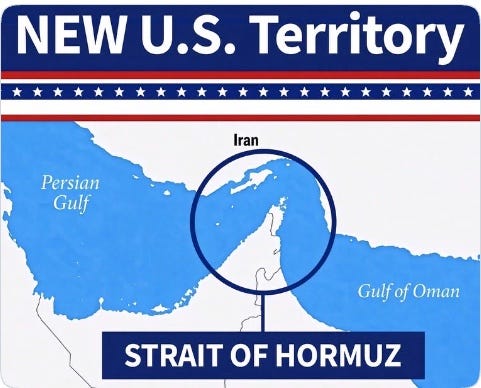
Twenty-One Hours (and now a Blockade)
Islamabad is over. No deal. Ceasefire Seems Over - Blockade ASAP
· 6 min read · 2 comments
Infinite Horizons | 12 April 2026
for reading! Subscribe for free to receive new posts and support my work.
Update — 12 April 2026, 2200 SGT
The ten days became hours. Shortly after Vance landed back in Washington from Islamabad, President Trump posted two consecutive statements on Truth Social that formally ended the ceasefire and announced a counter-blockade. The US Navy will blockade all ships entering or leaving Hormuz, effective immediately. Any vessel that has paid Iran a toll will be interdicted in international waters. Mines will be destroyed. Any Iranian firing at US or civilian ships will, in Trump’s words, be “BLOWN TO HELL.”
The second post stated the reason plainly: “There is only one thing that matters - IRAN IS UNWILLING TO GIVE UP ITS NUCLEAR AMBITIONS.” Trump acknowledged that most other points had been agreed at Islamabad, making them irrelevant in the same breath.
The ground option Niall Ferguson described below remains explicitly live. Trump described the US as “LOCKED AND LOADED” to “finish up the little that is left of Iran.” The ceasefire clock said 22 April.
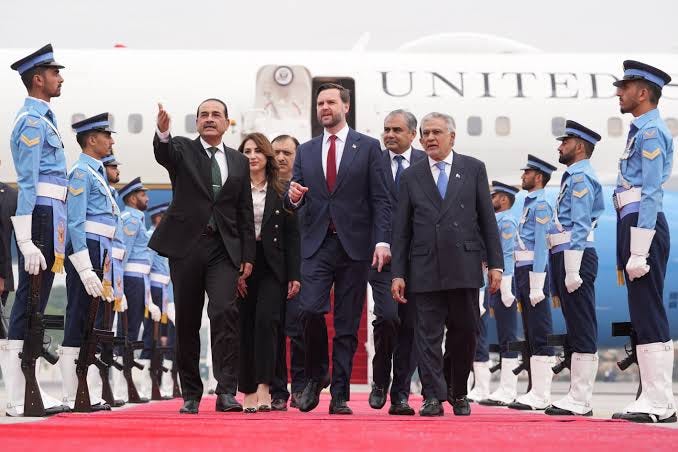
The counter-blockade said Sunday evening. talks are done. Twenty-one hours of direct face-to-face negotiations, the highest-level engagement between the United States and Iran since 1979, concluded Sunday morning in Islamabad without an agreement.
Original article at 1400 SGT 12th April
Vice President JD Vance told reporters before boarding for Washington that Iran had "chosen not to accept our terms." Iran's government posted: "Negotiations will continue despite some remaining differences." No next round has been announced. The ceasefire expires 22 April. Ten days remain.
What blocked a deal
The gap was structural. Enrichment is Iran's absolute red line, a sovereign right it will not surrender regardless of the forum. Trump said at Andrews before Vance departed: "No nuclear weapon. That's 99% of it." Those two positions cannot be bridged in a weekend. Hormuz is the second block: Iran's non-negotiable condition is full sovereignty over the strait; the US demands unconditional, uncoordinated opening. Pakistani sources told CNN the overall tone was positive, but the stalemate on Hormuz never broke. A source close to Tehran's team said the US made "unacceptable demands" over the strait. Iranian state media warned repeatedly through Saturday night that American demands were "excessive" and "overzealous."
Three areas showed partial movement: asset unfreezing, a possible Lebanon understanding, and non-aggression in principle. None of them are the sticking point. Hormuz is.
What Trump was doing while Vance was talking
At an Easter lunch last week, with Vance, Rubio and Hegseth in the room, Trump said: "If it doesn't happen, I'm blaming JD Vance. If it does happen, I'm taking full credit." While Vance sat in Islamabad overnight, Trump posted that the US was "clearing out the Strait of Hormuz as a favour to Countries all over the World," declared Iran "LOSING BIG," and told NewsNation he had "no idea" how the talks would go. Asked if he was hopeful, he replied: "Whatever, otherwise we'll reset. We're ready to go." Leaving for Miami on Sunday, he said: "Whether we make a deal or not makes no difference to me. We totally defeated that country."
Secretary of State Rubio, who previously called Iranian tolling of Hormuz "illegal and dangerous for the world," posted about an immigration enforcement case. He was not in Islamabad.
The Easter lunch prediction activated precisely. Vance flew sixteen hours, sat in a room for twenty-one, came out with nothing. Trump declared victory from Washington before the wheels left the tarmac.
China is in the fabric
China is not a spectator. CNN reported Saturday, sourced to three independent intelligence officials, that China is preparing to deliver MANPAD shoulder-fired air defence systems to Iran within weeks, routed through third countries to mask their origin. The Chinese Embassy denied the report. The weapon type is directly relevant: Trump confirmed a US F-15 was downed during the conflict by a "handheld shoulder missile, a heat-seeking missile." Iran said it used a "new" air defence system.
In a single week, Beijing persuaded Iran to accept the ceasefire, helped broker Islamabad, stayed publicly silent on the Hormuz joint venture proposal, and prepared a weapons shipment to rebuild the air defences Iran lost during the conflict. These moves are consistent with a single calculation: take diplomatic credit for de-escalation while ensuring Iran retains the military leverage that gives any future deal teeth. The silence on the joint venture is notable. China's own strait exposure makes any Hormuz precedent a direct template for the Taiwan Strait. Beijing is not going to endorse a sovereignty-sharing arrangement it may one day face itself.
The military clock
No US assets have withdrawn since the ceasefire. Assets are being added. Three carrier strike groups are now in or joining the theatre. The USS Boxer amphibious ready group surged from Hawaii on 1 April with Marines embarked. Pentagon planning reported by the Washington Post includes possible seizure of Kharg Island and coastal raids near Hormuz, with officials estimating "weeks, not months."
The mine countermeasure gap is critical. Two of three dedicated MCM ships are in Singapore for maintenance. Four of eight Avenger MCM vessels were decommissioned in September 2025. Trump's mine-clearing operation is running on destroyers, slower and higher risk. The military sustainability argument for closing this before 22 April is as strong as the political one. Every day of ceasefire with Hormuz unresolved drains Pacific readiness and defers the question to a harder moment.
My Scottish namesake and the brilliant historian Niall Ferguson, writing and speaking for The Free Press this week, identified the absence of a ground force deployment as the war's decisive miscalculation. Trump had three options at the ceasefire decision point: infrastructure strikes, the Pakistani channel, or a special forces and Marine operation to physically seize control of the strait. The third option, Ferguson argued, was almost certainly recommended by the Joint Chiefs. Not having done it left the US in a weak negotiating position. "It's hard to get the Iranians to let go of what they currently hold purely by sending Vice President Vance and hoping that he, Steve Witkoff, and Jared Kushner can charm the Iranians," Ferguson said. The ARG-MEU now at sea with the USS Boxer suggests that option remains available. Whether it activates before or after 22 April is the operational question the ceasefire clock is actually measuring.
Ten days
The Hormuz joint venture remains the only mechanism that gives Iran the sovereignty language it requires domestically and gives the US the passage it needs commercially. It is an uncomfortable resolution. Ferguson, writing with Richard Haass and Philip Zelikow in The Free Press on the eve of the Islamabad talks, gave the rather ugly JV idea of Trumps that I have written about, perhaps a concrete architecture: a Strait of Hormuz Company, constituted as a permanently neutral waterway under a new international convention, with shareholding distributed across the eight coastal states plus the US, China, India, Japan and South Korea. The framework is elegant. It internationalises the question, gives Iran a seat and a revenue share without granting it sovereign veto, and gives Asian economies a direct stake in keeping passage open. Ferguson's condition, however, is the one Islamabad failed to meet: Iran will not accept this unless military pressure makes the alternative worse than the deal. The ugly JV and the ground option are not in competition. The ground option is the price of admission for the JV.
Islamabad deferred the gap. Whether it closes quietly, in framework language neither side publicises, or whether 22 April triggers the next escalation cycle is now the only question on the board.
The ceasefire clock and the military readiness clock are running in the same direction. Hormuz remains shut, supplies of feedstock for Asian and European refineries dwindles. Ten days is not much time for an ugly resolution to find its language.
‐—————-
Ray Ferguson is a chairman and international banker with 35+ years of leadership across Asia, the Middle East, Europe and the Americas. Former CEO of Standard Chartered Singapore and SEA, UAE and Oman, and Deputy CEO of Bank ABC, Bahrain. Chair of Singlife. Singapore citizen, ocean sailor, board mentor, and author of the memoir Infinite Horizons: Seasons in the Sun - A Memoir of Leadership and Life. He writes on geopolitics, markets and leadership.
Thanks for reading! Subscribe for free to receive new posts and support my work.
Join the conversation
Comments and replies take place on Substack, where Ray reads and responds.
2 comments so far.
INFINITE HORIZONS
Get each edition by email
Free. Delivered by Substack. Unsubscribe from any email.
Infinite Horizons is published by World Scientific and available now.
Buy the book