The Big 'R" : World Where Resilience Eats Efficiency for Breakfast
A week away on a break from writing was long enough for a toll dispute to become a claim to own the strait outright by a distant power. What that, and four other developments, mean for Asia's boards.
· 6 min read · 1 comments
It has been about a week or more since I landed Who Gets to Charge for Hormuz, a wedding in Mallorca and the full eclipse in Galicia and travel home in between. It has been hard to catch up. Here is what actually moved.
What this means for a board, first
Treat the ceasefire as over, not paused. It lapsed yesterday with no extension, and intelligence reporting suggests Iran never intended it to hold. Plan on renewed disruption, not a resumption of talks.
Oman is no longer a safe assumption. A sitting US president has now threatened to bomb it by name. Any routing, insurance, or counterparty exposure that leans on Omani neutrality needs re-underwriting this week, not at the next renewal.
Partner states now pay a visible price for saying no. South Korea just found that out. If your own risk model assumed allied cooperation was free, it isn’t anymore, and that repricing applies wherever Washington has asked something regionally and been refused.
An unverified claim can still be a real signal. Treat fast-circulating, unconfirmed reports the way the best intelligence services do, as data about temperature, a read, not as fact to act on directly.
The bond market has already ahead of the game when I jyust checked …repriced around all of this. Thirty-year yields hit multi-decade highs today across the US, UK, Germany, France, and Japan simultaneously. Higher financing costs are the standing input now, not a temporary spike to wait out.
Why: the ceasefire
The sixty-day US-Iran ceasefire signed in mid-June lapsed Monday. Trump said “No” when asked about an extension. The Wall Street Journal reported this weekend, citing Arab and Iranian officials, that Iran’s hardline leadership decided within days of signing that the pact was cover for a later attack, not a genuine pause, and used the two months accordingly: expanded IRGC authority, veteran commanders reinstalled, missile and drone production accelerated, a new IRGC commander-in-chief installed. A senior Iranian official told Reuters Iran is now shifting to a “fully offensive” posture. If the reporting holds, this was never the pause it was sold as that calmed markets.
Why: the annexation claim and the Oman threat
Who Gets to Charge for Hormuz was the question a week ago, Iran, Oman, and Washington each staking out a fee for passage.
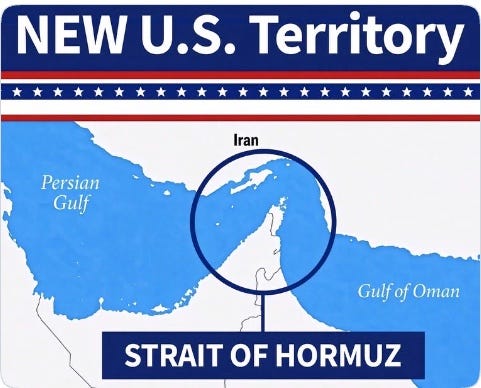
That question has now been overtaken by a bigger one. Trump has spent the past week claiming “total control” of Hormuz. Today he stopped saying it and posted a map above, the strait circled on Truth Social under the words “New US Territory.” This was unimignable a year ago.
Charging for passage assumes someone else still owns the road.
This is a claim to own it outright. Iran’s deputy foreign minister called it a delusion that would soon be corrected. Monday, before the map, he’d told Fox News the US would bomb Oman “if the Gulf nation gets in the way,” naming the one Gulf state that has stayed genuinely neutral through this entire war as a target.
The claim has no legal basis.
Maritime law specialists cited by CNN today said the strait belongs to neither state “in the ordinary sense of a piece of real estate,” freedom of navigation prevailing under UNCLOS regardless of what either government wants.
Iran and Oman are the actual littoral states, which makes Tehran’s own claim today, that it has already reached a transit-route arrangement with Oman, the sharper story underneath the theatre: Oman is negotiating with Iran on the exact waters Washington is threatening to bomb it over and then suggest annexing itself.
This series documented the same propagation risk once already in April, when one board got kicked over in 36 hours and Iran’s own toll spread to a floated Malacca toll within two weeks. A claim that a dominant state can annex a strait by enforcing the claim travels the same way, and hands China and Russia direct evidence that rules-based order was always conditional on naval strength.
Why: South Korea
Trump ordered Hegseth to “substantially reduce” joint exercises with South Korea, citing his relationship with Kim Jong Un. Buried in the same post: he’d asked Seoul to help “denuclearize” Iran, and got “No thanks.” He is now visibly cutting defence cooperation with an actual treaty ally over that refusal, a sharper and more public cost than anything the UAE or Egypt faced for declining pieces of the same ask earlier this year.
Why: the unverified claim
Marjorie Taylor Greene posted this weekend that nuclear weapons against Iran are being discussed in strategy meetings. Unconfirmed, and I’m treating it that way, she left office last month after a public break with the administration, and every outlet covering it labels it unverified. Naming it anyway because a claim circulating this fast is itself a signal. Nuclear deterrence was never built for a first-use scenario against a state with no weapon of its own to retaliate with, which is the entire stated reason for this war. That would not be deterrence. It would be the collapse of the one norm that has held every nuclear power back for all my life, more like eighty years.
Why: the bond market
The 30-year US Treasury yield touched 5.34% today, the highest since 2007. The UK 30 year gilt reached 5.86%, near its post-1998 high. Germany’s 30-year hit 3.78%, France’s 4.91%, Japan’s 4.16%, each a multi-decade high, all on the same day.
Jefferies’ economist put the mechanism plainly: long yields have been tracking oil. Two other forces are compounding it: US federal debt closing in on $40 trillion, and Big Tech’s own AI-infrastructure borrowing, on track for a record $1.9 trillion this year, now competing with governments for the same long-dated capital.
China alone is moving the opposite direction, its yields falling on weak growth while everyone else’s climb. Thats not a comfortable sign.
The operating principle
Sir Richard Moore, who ran MI6 from 2020 to 2025, said it better than I have, in a Fortune CEO Daily interview with Diane Brady last week: “resilience eats efficiency for breakfast.” His own case is for scenario planning over prediction, a discipline that belongs in a boardroom as much as a briefing room. He made a second point worth having here too: groupings no longer move as blocs, the Philippines breaking from wider consensus and facing up to China as his own example. South Korea saying no to Washington while still hosting American troops is the same pattern from the other direction.
None of today’s five developments adds up to resolution.
They add up to the argument this series has carried since April: watch what actually gets funded, staffed, or shipped, not what gets posted.
The big “R” is something this series has been discussing for weeks.
Resilience, not efficiency, is the operating principle for whatever comes next, and the world this settles into will never look like the one from February, ever.
Thats my sense after a week away, back at my desk tonight, where my dashboard suggests hang on to your hats.
Ray Ferguson writes the Infinite Horizons Substack. Signal Stack covers geopolitics and markets. Tech Stack covers AI and technology. Each edition is written plainly, for board-level readers, with evidence ahead of opinion and no patience for jargon. Full archive of previous Signal Stacks. Ray is a chairman and international banker with 35 years of leadership across Asia, the Middle East, Europe and the Americas. Former CEO of Standard Chartered Americas, CEO of Standard Chartered Singapore and SEA, UAE and Oman, and Deputy CEO of Bank ABC, Bahrain. Chair of insurer Singapore Life, 36ZERO Marine Group, and ESGpedia, Asia’s leading ESG data and technology company. Singapore citizen, ocean sailor, board mentor, and author of the memoir Infinite Horizons: Seasons in the Sun, Life & Leadership Lessons: A Memoir.
Join the conversation
Comments and replies take place on Substack, where Ray reads and responds.
1 comments so far.
INFINITE HORIZONS
Get each edition by email
Free. Delivered by Substack. Unsubscribe from any email.
Infinite Horizons is published by World Scientific and available now.
Buy the book