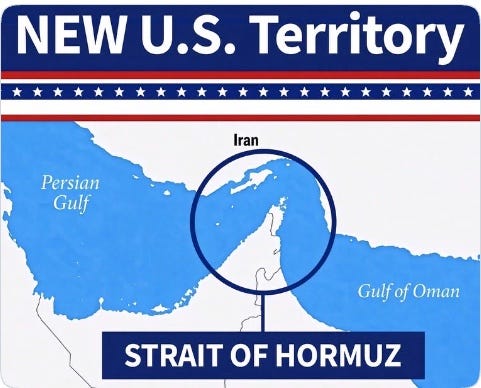
A Hormuz Chokepoint Precedent?
If Washington and Tehran agree in Islamabad to share the strait, every chokepoint on earth just became negotiable
· 9 min read
Infinite Horizons | Weekend Edition | 11 April 2026
Thanks for reading! Subscribe for free to receive new posts and support my work.

USA, is a country that used to derive its power by ponying up its brand of moral authority with its immense military power. It started the week threatening that “a whole civilization will die tonight, never to be brought back again,” threatening to destroy Iran’s energy infrastructure, bridges, and power plants if Tehran failed to meet his deadline for reopening the Strait of Hormuz.
The threat drew immediate and broad condemnation. Pope Leo called it “truly unacceptable”.
Now a few days on we had the TACO #7, have a ceasefire holding and the Islamabad summit opens this Saturday morning with the world watching for a durable end to the war.
The official agenda covers enrichment, Lebanon, sanctions and Hormuz. The stakes for getting this right are considerable. Energy supplies across Asia are tightening daily, supply chain dislocation is feeding inflation, and every week of closure extracts a compounding cost from the global economy.
But running beneath those formal headings, a different kind of deal appears to be taking shape, one whose implications could outlast anything formally agreed in the room.
Amidst noise in various intel circles, the clearest signal came on Wednesday, the day after the ceasefire was announced, when Trump spoke with ABC News. Asked whether he was comfortable with Iran charging tolls to tankers transiting Hormuz, he said: “We’re thinking of doing it as a joint venture. It’s a way of securing it, also securing it from lots of other people.”
That sentence and the three components of it, may prove more consequential than anything formally agreed this Saturday. Trump was not proposing to restore freedom of navigation. He was proposing to monetise its restriction alongside the country that imposed it.
Beijing, Riyadh, Abu Dhabi, Tokyo and Singapore were already listening before Trump said a word. Each has a different but acute stake in what emerges from Islamabad. China faces the prospect of its preferred Iranian oil discount disappearing into a dollar-denominated joint venture. Saudi Arabia and the UAE, having absorbed 41 days of Iranian missiles on their own infrastructure, now face the possibility that Washington endorses Iranian Hormuz management rather than dismantling it. Beijing, Tokyo and Singapore, routing the majority of their energy imports through Hormuz and depending on unimpeded passage through every major strait, are watching whether the world’s guarantor of freedom of navigation is about to become its co-monetiser. Hormuz is not merely a geographical feature. It is a chokepoint, the concentrated strategic power of a nation expressed through control of the passage on which the world economy depends. What Islamabad may ratify is the principle that such chokepoints can be owned, or joint ventured.
The business model, and the currency inside it
The structure has a precedent. America may claim it spent resources on regime pressure and rid us of a nuclear Iran. So America deserves a return. The leverage should generate revenue. Trump applied the same logic to arguments on the Panama Canal, to Greenland’s mineral deposits, and more physically to Venezuela’s oil fields. Is Iran is the next and largest version.
But there is a second dimension most commentary is missing. Iran’s toll demands have already cycled through three settlement currencies. Early in the conflict Tehran offered euros. This week, per the Financial Times, Iran is demanding Bitcoin. One consistent message: Tehran wants oil transit settled in anything other than US dollars. This is a direct assault on the petrodollar architecture underpinning American financial power since the 1970s.
A joint venture resolves that problem for Washington. If the US enters a co-management arrangement at Hormuz, the operational framework would almost certainly be denominated in dollars. US naval coordination, security guarantees, energy company participation in reconstruction contracts, all carry dollar flows. The joint venture does not merely give Trump a revenue argument domestically. It could re-anchor Hormuz settlement in the dollar at the precise moment Iran was trying to move it out, structurally braking the petro-yuan growth story at the world’s most critical chokepoint. Precisely at the point when the continuation of US debt financing by Asian surplus nations is precarious.
The Montreux template: freedom of passage that is not free
Before dismissing this as legally incoherent, consider the Bosphorus. Governed since 1936 by the Montreux Convention, Turkey describes its freedom of passage as something that “cannot be interpreted to mean free and unregulated passage.” Turkish authorities regulate traffic and collect pilotage fees. Iran’s negotiators know this precedent. Such a framework, with Iranian coordination required and fees collected, is not a violation of international maritime principle. There is a sort of template.
That said Hormuz like Dover, Gibraltar, Malacca, Singapore are Straits Used For Navigation under UNCLOS, so they are different. The United States never ratified UNCLOS precisely because it imposes constraints on American naval freedom. A joint US-Iran toll regime at Hormuz would violate the guarantee of transit passage. As non-signatory and co-operator, the US would face no legal obligation to uphold it and would likely veto any Security Council challenge to it anyway.
China’s lesson
The Taiwan Strait, at its narrowest around 130 kilometres wide, sees 44 percent of the world’s container fleet pass through it annually, per CSIS. Eighty percent of China’s imports transit it. Ninety percent of the world’s most advanced semiconductors are manufactured on the island at its eastern edge. The Taiwan Strait is a chokepoint of equivalent strategic power to Hormuz, narrower, more contested, and sitting at the intersection of the US-China rivalry that will define the next decade.
But China, I suspect, will tolerate a Hormuz joint venture rather than contest it, at least for now. The evidence of what Beijing has been doing while the war was being fought is instructive. China’s official military outlet published five lessons from the Iran conflict in March. Former US CENTCOM commander Joseph Votel noted China is “paying very close attention, learning how we respond to counterfire, following our air tactics.” ISW and AEI assessed China “will likely closely study tactical and operational lessons learned from the conflict, as it has done in Ukraine.” China imported 16 percent more oil in early 2026 than the same period last year, building a 1.2 billion barrel strategic reserve, perhaps as preparation for a Taiwan contingency. In December 2025 the PLA conducted Justice Mission 2025, its most extensive Taiwan blockade rehearsal ever.
China is perhaps not watching the Hormuz precedent with alarm. It is watching it with professional interest. If China were to challenge a US-Iran joint venture through international mechanisms, it could risk establishing that strategic waterway management by coastal powers is legally contestable, a precedent that could apply directly to its own stated ambitions in the Taiwan Strait.
China’s short-term commercial interest is clear enough: it wants Hormuz fully open, its oil flowing and its tankers moving without paying anyone. That desire is shared by every nation. The silence from Beijing on the joint venture proposal being floated is therefore not indifference to the toll. It is, I suspect, a more deliberate calculation: is it that contesting the precedent now would complicate a playbook Beijing may one day wish to use itself?
The second-order precedents
The Strait of Malacca and Singapore sees more oil and container trade than Hormuz. The commercial interests of Singapore, Malaysia and Indonesia in keeping it safe, efficient and freely transitable have been tightly aligned for decades. But the legal and strategic architecture that kept it uncontested is about to be significantly weakened in an Islamabad conference room this Saturday.
The Bab-el-Mandeb at the entrance to the Red Sea is another case. The Houthis have spent two years demonstrating that a non-state actor with Iranian missile technology can effectively tax commercial shipping through one of the world’s busiest corridors. The Hormuz precedent does not only apply to states. It applies to any armed force capable of sustained denial, willing to wait for a negotiated arrangement that confers de facto legitimacy on the obstruction.
Iran’s leverage will not be permanent. Saudi Arabia and the UAE will expand bypass pipelines. Within five years the Persian Gulf will have materially better circumvention options. The Islamabad talks are happening inside a closing window. Iran’s leverage is at its peak today. Tehran knows this.
What to watch in the Islamabad readout
The communiqué language will be studied carefully. Four things in the readout will tell you whether the soft version of the joint venture is already being built.
Watch for any reference to “coordinated management” or “joint security framework” for Hormuz: these are the diplomatic synonyms for joint venture. Watch for whether sanctions relief is described as conditional on Iranian compliance rather than tied to a specific timeline. Conditionality language means the commercial architecture is already being constructed. Watch for whether the enrichment question is “deferred to a technical working group” rather than resolved. Deferral is how the US avoids a public concession while accepting the operational reality. And watch for what is not said about Lebanon. If the readout is silent on Lebanon while Netanyahu’s strikes continue, the ceasefire’s structural flaw has been accepted by all parties as the price of keeping Islamabad alive.
If three of those four signals are present, the joint venture is already underway in everything but name.
I have spent the better part of four decades either living in and working across the trade and investment corridors of Asia, the Middle East and the West, running banks, sitting on boards, watching how these economies process geopolitical risk. The assumption underlying every investment decision was that the many straits through which trade flows would remain governed by international rules rather than the commercial interests of adjacent or even distant powers.
That assumption is now formally in question. Singapore’s government has understood the stakes faster than most. In parliament deliberations on 7 April, four days before Islamabad, Singapore’s position was stated with unusual precision: transit passage through international straits is a right, not a privilege to be granted by bordering states, not a licence to be supplicated for, and not a toll to be paid. To negotiate on toll rates, parliament was told, would be to implicitly erode the legal principle on which Singapore’s own security rests. The geographical point followed: the narrowest point at Hormuz is 21 nautical miles. The narrowest point in the Strait of Singapore is less than 2. More maritime oil and container trade flows through the Straits of Malacca and Singapore than through Hormuz itself.
On the morning of the Islamabad talks, Singapore’s government reinforced that position in the national broadsheet. An op-ed by a Minister of State published today hours before the meeting restated the principle with directness : transit passage cannot be negotiated, cannot be suspended, and tolls are forbidden, all under international law. The timing is not accidental.
That position, stated as an absolute principle before Islamabad begins is now maybe going to become in direct tension with Washington's emerging joint venture proposal floated by the President. What emerges this weekend, and in the further rounds that follow, will indicate whether the old Grotian principle that the sea cannot become the possession of any one power survives its most serious test in four centuries, or whether geospheric lines are being redrawn in ways that prove very difficult to reverse.
Ray Ferguson is a chairman and international banker with 35+ years of leadership across Asia, the Middle East, Europe and the Americas. Former CEO of Standard Chartered Singapore and SEA, UAE and Oman, and Deputy CEO of Bank ABC, Bahrain. Chair of Singlife. Singapore citizen, ocean sailor, board mentor, and author of the memoir Infinite Horizons: Seasons in the Sun - A Memoir of Leadership and Life. He writes on geopolitics, markets and leadership
.
Thanks for reading! Subscribe for free to receive new posts and support my work.
Join the conversation
Comments and replies take place on Substack, where Ray reads and responds.
INFINITE HORIZONS
Get each edition by email
Free. Delivered by Substack. Unsubscribe from any email.
Infinite Horizons is published by World Scientific and available now.
Buy the book